Beef Market Advisor

Monday, March 03, 2008


2008 Business Plan for Grass Cattle in the Emerging Biofuel Era

By
Harlan Hughes
Professor Emeritus
North Dakota State University

Planning Prices for Grass Cattle

(double click the figure images to load a larger version into yout computer. Then, use your browser print option to print the figures. Click back on your browser to return to the text of this article.)

My 2008 ranch business plan for the emerging biofuel era calls for the marketing of heavier feeders off grass. Looking at Sep08 planning prices in my April08 BEEF Market Advisor, Figures 4, suggests a $126/cwt planning price for 625 lb steer calves going on grass in May08.

Figure 1 above presents my detailed Sep08 futures-based planning prices for alternative animal weights. Since I wanted to evaluate the production of 850 lb feeders off grass, I selected the $108/cwt planning prices for my 850 lb steers off grass in 2008. This is an Eastern Wyoming/Western Nebraska planning price.

Grass Cattle Profit Center Budget

Now that I have my planning prices for running grass cattle in 2008, I can now project my resource costs for running grass cattle in 2008. This, then, gives me a grass cattle profit center budget for running yearlings on grass in 2008 (see Figure 2 above).

In summary, the buy/sell margin for 2008 grass cattle is projected to be a minus $18.35. This generates a $115 marketing loss on the initial 625 lbs. To make a profit, the profit from the pounds gained has to exceed the marketing loss.

The market value of the 225 lbs gained is projected to be $242 with a total cost of gain at $126/head for a projected profit on the lbs gained of a $116. The per lb cost of gain is projected at $0.56/lb. Adding the marketing loss to the gain profit gives only a $1 profit overall. I would, however, get paid $15/steer month for my grass.

No labor charge, however, is included. If labor cost were to be added in, I typically use $15/head labor costs. Instead, I am letting unpaid labor be one of the residual claimants in the bottom line along with facilities, management, and risk. All three of these resources are not charged for in this economic analysis.

Management Actions

Let's review what I did. In the April08 BEEF Market Advisor I used CME futures market for a given contract month as my base planning price. I then localized this CME price to my geographic location via the basis adjustment giving me a futures-based localized planning price. I then adjusted the localized planning price by my calculated price slides to adjust the planning price to my specific weight of cattle being marketed. I arrived at a May08 $126 price on grass and a Sep08 $108 price off grass.

Then in this article, I prepared a profit center budget utilizing these planning prices for wintering steers on grass summer 2008. I then integrated that grass cattle profit center budget into a business plan for running fall calving cows in 2007.

Economic Analysis of a 2007 Fall Calving Beef Cow Herd

The grass cattle budget discussed above is integrated into a set of four production/marketing alternatives for a Fall 2007 Calving Cow Herd (see Figure 3). The grass cattle budget is the 3rd marketing alternative from the left in Figure 3.

As you probably can guess, the exact same procedure as described in detail for the grass cattle profit center was used to generate the beef cow herd profit center budget, the wintering profit center budget, and the finishing profit center budget for a complete economic evaluation of a fall calving cow herd.

The 2007 fall born calves are wintered in 2008, summer grazed in 2008, and finished in the fall of 2008/winter 2009. Now I can evaluate four different marketing points for running a fall calving beef cow herd. The four marketing points are:
• Selling at weaning,
• Wintering the calves through the winter,
• Running the calves as grass cattle through the summer, and
• Finishing the grass cattle off grass.

Line 44 in Figure 3 presents my projected profits for each marketing point:
• Selling at weaning with $60 projected profit per cow,
• Selling at grass time with an added $25 projected profit per calf,
• Selling off grass with an added $4/head (a rounding difference of $3 from Figure 2) projected profit per calf, or
• Selling finishing the animals with a negative projected profit of $139 per head.

Remember, these profits are accumulative as you go from left to right. Even if I take my potential profits from selling at weaning, wintering the calves, and running grass cattle, and subsidize the finishing profit center,( a common rancher practice), I am projected to not make any money finishing these calves. Why, then, would I want to finish these calves?

Also, for income tax purposes, the first 3 marketing points all would occur in 2008 so there are no different tax consequences.

My conclusion from this 2008 ranch business plan is that I am interested in keeping my calves through Sep08 and marketing the calves as feeders off grass. I am not interested, at this point, is finishing these calves.

posted by Dr. Harlan Hughes 8:42 PM [edit]

Friday, February 22, 2008


Northern Plains Benchmark Herd Data

Since it is that time of the year when we analysis the production of our 2007 claves and start working on plans for the production of 2008 calves, I have elected to share a set of herd performance benchmarks from the Northern Plains. I wonder how your herd compares to these benchmark herds' numbers?

A question was raised as to what the letters in the column heading meant on the above benchmark table.

SPA = Standardized Performance Analysis -- measures defined in the published National Cattlemens BBeef Association SPA Standards.

CSF = Critical Success Factors


Double click on the figure to load a larger version of the table into your computer and then you can use your browser's print option to print out this benchmark table.

posted by Dr. Harlan Hughes 9:25 AM [edit]

Sunday, February 17, 2008

Price Forecasting -- Part I

Producer often tell me that one bottleneck to Strategic planning of marketing is not knowing which planning prices to use. Thus, I am sharing with ranchers my forecasting and marketing strategy evaluation techniques. It consists of two parts. First, I prepare an extensive set of planning prices for the next 12-18 months. Second, I enter them into an expanded set of enterprise budgets that project the gross income, resource costs and earned economic net returns for alternative marketing strategies. Due to limited space, this column will focus solely on the development of my latest set of suggested planning prices.

...more (click the "more" hotbutton to see the complete article in BEEF Magazine, January 2008.

posted by Dr. Harlan Hughes 3:53 PM [edit]

Price Forecasting -- Part II

Ranchings economics is changing. Preliminary data suggest the cost of running a beef cowherd has increased 15-20* in the list two years. Altered production costs and rising feed and livestock prices are generating a different set of ranch-level, cost-and-return (C&R) relationships. And it's imperative that ranchers have a good handle on their herd's annual costs and returns in this emerging biofuels era.
Ranchers must ask themselves: "Does the emerging biofuels era favor a different ranch-level production/marketing system?" If so, what is optimum for you?

….more click the "more" hot button to see the complete article in BEEF Magazine February 2008.

posted by Dr. Harlan Hughes 3:30 PM [edit]


Beef Cow Herd Liquidation On The Horizon?

Source: Cattle Network Today 2/15/2008

(Please note my editorial comment at end of this article)

Rising costs, and prospects for lower calf prices, could lead to the U.S. beef cow herd declining over the next several years. USDA's Cattle inventory report, released a couple of weeks ago indicated that the January 1, 2008 beef cow inventory was about 1% smaller than a year earlier. Most observers think drought conditions, particularly in the Southern Plains during 2006 and the Southeastern U.S. during 2007, prevented U.S. producers from expanding their herds the last two years. This line of thinking suggests that, if weather conditions return to normal, cow herd expansion is on the horizon. But the delayed expansion is not likely to turn into future herd expansion. The reason is simple.

For most U.S. cow-calf producers, there is simply no compelling profit motive to expand their herds. And rapidly rising costs, and stiff competition for pasture, are actually likely to lead to modest herd liquidation in 2008.

Kansas Farm Management Association data indicate that cow-calf producers' returns above variable production costs have been positive for the last nine years (including projected returns for 2007,actual 2007 data won't be available until later this spring), but the margin has been declining rapidly the last two years. And combining forecasts for lower calf prices in 2008 with a dramatic upturn in production costs, including higher feed grain prices, pasture rental rates, fertilizer prices, hay prices, and transportation costs, odds are high returns for average cost cow-calf operations will fall below variable production costs in 2008.

Recent cow slaughter data tends to support this view. Beef cow slaughter during 2007has 6.6% larger than in 2006 and, during the first five weeks of 2008, was nearly 10%larger than a year earlier. Total female slaughter (cow and heifer slaughter, combined) expressed as percentage of steer slaughter is running ahead of last year and at a level that suggests liquidation is taking place. During the first five weeks of 2008, female slaughter totaled 101.6% of steer slaughter, well ahead of last year's pace during January of 96.2%. So, one of the early by-products of the ethanol induced run-up in grain prices could well be the beef cow herd expansion that didn't happen!

Editorial comment from Harlan Hughes: While I totally agree with the general theme of this article, I suggest readers think about one more aspect of the beef industry as you read this. "The role of beef cows in U.S. agriculture is to harvest land that should not or can not be farmed." Beef cows have never really been able to compete with "farming" when that land could be farmed. The emerging biofuel era is again emphasizing that land that can be farmed will be farmed. The nations beef cow herd could well reduce in size due to the bio fuel era.

Now for the key point. The great-plains and mountain regions are not going to see this conversion from beef cows back to farming -- I think it will be the western corn belt and southern plains regions. As a result, the nations beef cow herd will move west in the biofuel era. Those remaining in the beef cow business will have less competition from the corn belt and southern beef cow producers.

posted by Dr. Harlan Hughes 11:45 AM [edit]

Friday, February 15, 2008


Economics of Running Grass Cattle In The Summer of 2008 - Part II


Part I of this series was devoted to developing a set of planning prices for running grass cattle. This article will focus on the total budget generated to evaluate the economics of running grass cattle the summer of 2008.

Projecting The Profit From The Lbs Gained On Grass

Figure 1 illustrates the Wyoming production costs that I used to generate a budget running grass cattle in Wyoming during the summer 2008. This table illustrates the projected costs of individual production costs item by item.

In this Wyoming budget, the opportunity cost of grass was included at $17 per steer month for a total of 3.8 months for a total grass cost of $65 for the season. Note that a labor costs of $15 was also included. The projected total production costs come to $132 per head for a $0.66 per lb cost of gain.

The Projected Final Economic Summary

Figure 2 summarizes the combined projected marketing loss and gain while on grass. The projected $48 bottom line is the “earned returns to management, equity capital, and risk.” Given the projected $114 projected purchase price, the breakeven selling price is $103 per cwt. – very close to the guaranteed insurance policy Ranch-Gate-Price discussed in Part I of this series.


What If” ADG Was Not 1.75 Lbs?

The target ADG was 1.75 lbs per day but what if this rancher experienced experiences a different ADG? Figure 3 presents some “what if” projections. For example, if the ADG turns out to be 1.50, the animals are projected to weight 821 lbs at selling time; however, due to he small price slide at this weight, the selling price is projected to go up only $0.82 for a gross income of $876 per head. With a $122 purchase price (see the bottom half of table) and a 1.5 ADG, the projected profit per head is a minus $36/head.

Figure 4 presents a complete 2008 Wyoming grass cattle budget for running 650 lb steer calves on grass in the spring of 2008 gaining 200 lbs and selling off grass at 850 lbs. A “your farm” column is available for you to modify this budget to fit your specific grass cattle situation.

posted by Dr. Harlan Hughes 9:46 AM [edit]

Thursday, February 14, 2008


Economics Of Running Grass Cattle In The Summer Of 2008- Part I

Figures 1, 2, and 3 are at the top printed in reverse order. Double click each to load a larger view into your computer and to print with your browser's print command. You can go back to the print section by clicking the back arrow on your browser.


In response to this changing economic world, a Wyoming IRM Cooperator asked me to help him evaluate the economics of running grass cattle during the 2008 grazing season. He was wondering if he could purchase some 650 lb calves in early May and market them at 850 lbs in mid September 2008 and make any money.

Given the price volatility of corn and its direct impact on feeder cattle prices, he wanted to explore using USDA’s Livestock Risk Protection (LRP) Program to remove most of price risk associated with running yearling steers. The objective of this article in the series is to share the economic analysis that I went thorough to provide this IRM Cooperator’s a set of planning prices for running grass cattle summer 2008.

Ranchers need to answer two economic questions to determine the profit potential from running grass cattle in 2008. First question, how much marketing loss is projected on the initial weight of the feeder calves going onto the grass? This is determined by the magnitude of the negative buy/sell margin times the initial weight of the feeder calves. Second question, what will be the projected profit generated from the pounds gained during the grazing season? The projected profit potential from running grass cattle in 2008 is the sum of these two numbers.

Projected Buy & Selling Price For Yearlings On Grass In 2008.

I will describe two price forecasting tools that I will use to suggest a projected buy/sell margin for grass cattle in 2008. The results of these two projection models are presented in Figures 1 and 2.

Figure 1 suggests that buying 650 lb feeder calves in spring 2008 is projected to cost $114 per cwt (determined by extrapolating between the 600 and 700 lb prices under the Spring08 column in Figure 1; row 10, col U). Figure 1 also projects 850 lb feeder steers in September 2008 to sell for $103 (row 14, col V). These two prices, then, suggests a buy/sell margin of a minus $11 ($103 - $114). Taking 6.5 cwts x -$11 gives a projected -$71.50 marketing loss associated with these grass cattle.

Market price basis is defined as local cash price minus future market price. The above price projections are based on a +$4.16 market price basis for 650 lb feeder calves and a -$8.02 market price basis for 850 lb feeder steers. These basis numbers are based on the basis actually experienced in Western Nebraska the week of 23 Jan 2008. We know, however, that market price basis changes through out the marketing year. Experienced marketers also know that basis risk is the one risk that can not be passed on to someone else.

So...What Market Price Basis Should I Use?

There is now a comprehensive basis projection model available to ranchers that was just recently released by Kansas State University (see BEEF January Issue). This model is accessible at www.beefbasis.com. This model not only gives a projected market price basis by state (in my example Wyoming), it also provides a projected confidence interval for that basis projection.

The input used by Beefbasis.com was state where the cattle are marketed, average weight of the feeders to be sold, number of head and the target selling date. The model retrieved the appropriate live cattle futures price, feeder cattle futures price, and the appropriate corn futures price selected for my targeted marketing date. All of this is reported in the top-half of Figure 2.

The Beefbasis.com Model presents two different projected results summarized in the bottom-half of Figure 2. The first projection is based on Wyoming’s historical feeder cattle prices and projects a minus $4.43 average basis for September 2008. Due the high volatility of current prices, the 68 percent confidence interval for the basis forecast is wide and ranges from -$0.77 to -$8.09.

The second projection in Beefbasis.com model also takes live cattle and corn futures prices into account and it projects an average basis of a minus $0.03 with a confidence interval of -$4.02 to +$4.22. I have elected to use the average of these two basis estimates and settle on a minus $2.23 Wyoming basis for this study. This Beefbasis.com Model can be used to calculate a local basis for your ranch by taking your state’s historical prices into account.

The Beefbasis.com model also provides an expected cash price of $105.47 in the feeder cattle model and $109.87 in the Live Cattle & Corn Model for an average projected selling price in September of $108.

Both the PPP-MIS Model and the Beefbasis.com Model are futures based. The primary difference in the planning prices projected by these two models is the basis projections. The Beefbasis.com projection model is built around considerably more historical price data which, in turn, should lead to more accurate basis predictions.
Using Livestock Price Protection (LRP) To Guarantee A Selling Price.

In recent years, USDA has been offering various new price risk protection programs for ranchers. My Wyomig rancher wants to take the guaranteed market price from a LRP price insurance policy and work backwards to see what he can afford to pay for feeder calves going onto grass.

The USDA insurance coverage price is based on the futures options market so the insurance premium and coverage price changes daily along with the options prices. You can look at the daily price quotes at

http://www3.rma.usda.gov/apps/livestock_reports/main.aspx

Figure 3 summarized my personalized worksheet that I use to calculate the insurance coverage price at the ranch gate. The insurance coverage price is labeled the “Ranch-Gate-Price” on the right-hand side of Figure 3.

You take the coverage price from the USDA daily Price Table, use the provided premium rate, adjust it for the USDA premium subsidy, and, in my example, you get the $3.74/cwt premium rate that the rancher pays that day. The “Net Price” is the insured price after the premium is taken out and “Ranch-Gate-Price” is the net price adjusted for local basis. The premium and Net Price can be locked in the day the premiums are paid . The basis, however, is a projected value so the final Ranch-Gate-Price can vary a little from the projected price. That variance will be the error generated in the basis forecast.

To initiate an LRP insurance contract. a ranchers signs up with his local crop insurance agent and pays his premiums. The contract includes that day’s specific price coverage and insurance premiums inserted for that day, All insurance costs are paid up front and there are no hidden costs like “margin calls” in this insurance program.

In this case, a Wyoming rancher could have signed up for an LRP insurance policy on Jan 29, 2008 that would have set the insured Ranch-Gate-Price at $100.03 per hundredweight for 850 lb feeder steers to be sold in late August.
In summary, I used $114 dollar feeder calves going on grass and $108 dollar feeders cattle coming off grass. USDA’s risk management Livestock Risk Protection (LRP) was evaluated setting the insured price at $100 per cwt. We now have a set of suggested planning prices that can be used to prepare a total budget for running grass cattle during summer 2008.

Next month I will present the actual 2008 grass cattle budget generated for this IRM Cooperator.

posted by Dr. Harlan Hughes 1:34 PM [edit]

Tuesday, February 12, 2008

2007 FEEDLOT REVIEW

According to the Kansas State University "Focus on Feedlots"
survey for calendar year 2007, feeding performance for steers
and heifers deteriorated compared to 2006's. Average closeouts
weights were about unchanged in 2007 compared to 2006. As
expected, in 2007, the cost of gain for both steers and heifers was
well above the prior year, reflecting surging corn and hay costs.
In 2007, the average closeout weight for steers was 1314 pounds
or about 2 pounds heavier than 2006's and 43 pounds above the
2001-2005 average. Heifers closed out at an average 1189
pounds, down a tad from the 1192 pounds reported for 2006 and
3 percent higher than the prior five-year average. In November
steer closeout weights peaked at 1404 pounds while heifer
weights topped out at 1242 pounds in October. In 2007,
placement weights for steers averaged 781 pounds, 5 pounds
heavier than 2006's, while heifer placements weights were down
about 12 pounds.

For reporting feedlots, steers in 2007 were on feed an average
162 days, nearly 4 days longer than in 2006, while heifers were
on feed an average 9 days more than a year earlier. Average
daily gains for both steers and heifers worsened compared to
2006's, as feedlots reported an average daily gain for steers at
3.31 pounds per day versus 3.40 pounds, with heifers at an
average 2.94 pounds per day which was 3.5 percent lower than
2006's. For steers and heifers sold in 2007, the amount of feed
needed per pound on gain dry matter basis was higher than in
2006. Steers required an average 6.19 pounds of feed, up from
the 5.95-pound average for 2006, whereas heifers needed an
average 6.42 pounds well above the prior year's 6.19-pound
average.

As expected, feedlots reported record high feeding cost of gain for
2007 due to higher corn and hay prices. For 2007, the cost of
gain for steers was $73.51 per cwt. versus $53.94 per cwt in 2006
and over $21 per cwt. higher than the 2001-2005 average. Heifers
closed out at an average $77.91 per cwt., $20.81 per cwt. higher
than 2006's average. For 2007, feedlots reported an average corn
price of $4.12 per bushel, $1.43 per bushel higher than 2006's,
with corn prices only dropping below the $4 mark twice late in the
2007 year. The annual price for alfalfa hay at $135.12 per ton
was the highest ever reported for calendar year and was nearly
$28 per ton above 2006's.

posted by Dr. Harlan Hughes 11:01 AM [edit]

Cattle Cycle Gone -- Production Cycle Here

"From an inventory standpoint, I think the cattle cycle is dead," said Randy Blach, Cattle-Fax CEO, at that organization's Outlook Seminar last week.

He and other Cattle-Fax analysts explained the cattle cycle is evolving into one defined by production and technology where the same or more beef can be produced with the same or fewer cattle.

They expect the soft liquidation of beef-cow numbers last year (see "Cow Numbers Decline" elsewhere in this issue) to continue this year; numbers should remain stagnant at best for the next several years. Yet, there's little reason to expect beef production will decline much.

Besides the technology enabling heavier carcass weights, Blach explained, "We will rely on countries like Canada and Mexico to supply more of the raw material (fed beef and feeder calves) we need to run the factory here."

According to Kevin Good, Cattle-Fax analyst, the U.S. will import about 2.5 million head this year. Even so, U.S. per-capita consumption will decline slightly because of supply, not demand.

Though cattle supplies are running tight, Good says Cattle-Fax believes more cattle will be placed this month and next than popular perception suggests because more calves were placed into grower yards than people think. Popular reasoning has figured most all the calves that would have gone to wheat pasture last fall and couldn't were placed directly on feed.

For prices next year, Cattle-Fax is calling 550-lb. calves at $115 for average (range of $110-$125), 750-lb. feeders at an average of $104 (range of $94-$116), and fed cattle at $92-$94 on average (range of $85-$102).

If these estimates are in the ballpark, selling prices remain near historically high levels. Unfortunately, input costs will continue to rise, pressuring net profit potential.

For instance, Cattle-Fax analyst Mike Murphy said more acres of corn than last year's record level are needed this year at similar yield levels to avoid upward price pressure, given burgeoning corn demand. Raw demand and the weak U.S. dollar boosted U.S. corn exports to a record high last year at 2.45 billion bu. Meanwhile, global corn consumption has exceeded global corn production four of the previous five years.

"Higher prices should ration demand, but we're not seeing it," Murphy explained. Wheat and soybean prices are record high on the board and come with lower input costs. Bottom line, corn acres are expected to decline by at least 4 million acres this planting year.

"Last year's large acreage numbers took some pressure off yields. With a smaller number of acres, there will be more pressure to maximize yield potential," Murphy said. Cattle-Fax expects corn to run $3-$5/bu. this year, barring a hiccup in production, and with plenty of volatility.

On the other side of that, Blach believes there's plenty of opportunity because so many more points of differentiation are available in the market. Whether it's source and age verification, natural, or any of the other value-added attributes, Blach expects price spreads that are already record wide for same-weight, same-class cattle to widen even further.

"You're going to have to embrace more risk management in your operations," Blach said.

Overall, USDA's Economic Research Service predicts the Consumer Price Index (CPI) for all food will increase 3-4%, as retailers continue to pass on higher commodity and energy costs to consumers in the form of higher retail prices. The all-food CPI increased 4% between 2006 and 2007, the highest annual increase since 1990.

posted by Dr. Harlan Hughes 10:48 AM [edit]

Saturday, August 11, 2007

BeefTalk: Wrecks Are Not Desireable; Vaccinate Your Calves Now

The process of getting calves ready for market is not simple. In days past, calves generally were not handled or worked prior to shipping in the fall. Instead, they were gathered, sorted and hauled directly to the auction barn.

Calves would not be separated from their mothers prior to sale and the bawling of fresh-weaned calves echoed from the local sale barns. These calves did well and many returned to the countryside for a more leisurely feeding period in smaller lots or pastures.

Today, the table has turned. Many calves go directly to feed yards that aggressively feed calves. In many ways, this is a culmination of genetic selection for growth and the availability of reasonably priced feed grains available in sufficient quantities that facilitate the operation of large feed yards.

Standing at the entrance of a large feedlot today, one would see a constant flow of tractor-trailers loaded with feed or loaded with calves, courtesy of a very efficient transportation system.

In terms of filling trucks with calves, today's buyers do not have a few select orders that offer a premium. Today's buyers have a standard order that fills large pens in large feedlots with similar types of calves that are preconditioned for such an environment.

The bottom line is that the need for preconditioned calves is now the norm, not the exception. At the Dickinson Research Extension Center, in response to the recommendation of our local veterinarian and in preparation for this fall's shipping, the calves were vaccinated with a seven- way clostridial, including blackleg caused by clostridium chauvoei; malignant edema caused by clostridium septicum; black disease caused by clostridium novyi; gas gangrene caused byclostridium sordellii; enterotoxemia and enteritis caused by clostridium perfringens types B, C and D; and histophilus (haemophilus) somnus.

The calves also received a five-way viral product at branding for infectious bovine rhinotracheitis, bovine viral diarrhea types I and II, bovine respiratory syncitial virus and bovine parainfluenza 3.

The cost of these products was 76 cents for clostridial/somnus vaccine and $1.86 for the five- way viral product. Two to eight weeks prior to weaning, a booster vaccine is administered for clostridial/somnus and the five-way viral.

At the same time as the booster vaccination, calves receive their initial vaccination for mannheimia (pasteurella) haemolytica. The cost for pasteurella is $2.32 per dose. The booster vaccinations cost 76 cents for clostridial/somnus vaccine and $1.86 for the five-way viral product.

At weaning, the calves again will receive all three vaccinations at a cost of $4.94. The calves would not need to be vaccinated at arrival at the feedlot because they should be fully prepared for the transition.

The total cost for the vaccination program is $12.50 per calf.

This is a fairly aggressive vaccination program, but these calves are heading to the feedlot. For every 100 calves in the feedlot, the death of one calf would be more costly than the price of an aggressive vaccination program.

In addition, the nature of many of these diseases, if ever encountered, seldom involves just one animal. The reality of an outbreak is that a significant number of calves will be sick. The lost performance, lost value on the rail and actual treatment costs combine to produce what most cattle producers call a wreck.

It's best to not go there, so vaccinate the calves.

May you find all your ear tags.

Source: Kris Ringwall, Beef Specialist, North Dakota State University

posted by Dr. Harlan Hughes 3:54 PM [edit]

Tuesday, June 12, 2007

Please check out my 2nd Web Page at www.beefcharts.blogspot.com

posted by Dr. Harlan Hughes 8:43 PM [edit]

Friday, March 30, 2007


Cost Of Home-Raised Replacement Heifers


Fall calf prices peaked in 2005 and the current beef price cycle is projected to

trend somewhat lower for a few years as the current beef price cycle plays out.

Measuring and controlling heifer replacement costs over the next three to four years

will become all critical.

Managing home-raised replacement heifer numbers has considerable impact on

UCOP - much more so than ranchers typically believe. The quickest way to increase

the unit cost of producing a hundredweight of calf (UCOP) is to hold back added

replacement heifers. The quickest way to lower UCOP is to decrease the number of

heifer calves to be held back to be developed into replacement heifers.

Cash accounting, as done by most ranchers, will lead ranchers down a prim-rose-

path over the next 3 or 4 years with respect to the costs of raising replacement

heifers. In fact, I am currently projecting that some ranchers will loose a

substantial amount of money raising replacement heifers over the next few years and

they will probably not even be aware of it!

A complete version of this article will be published in the BEEF Magazine, May 2007 issue.

How To Print The Two Input Forms:

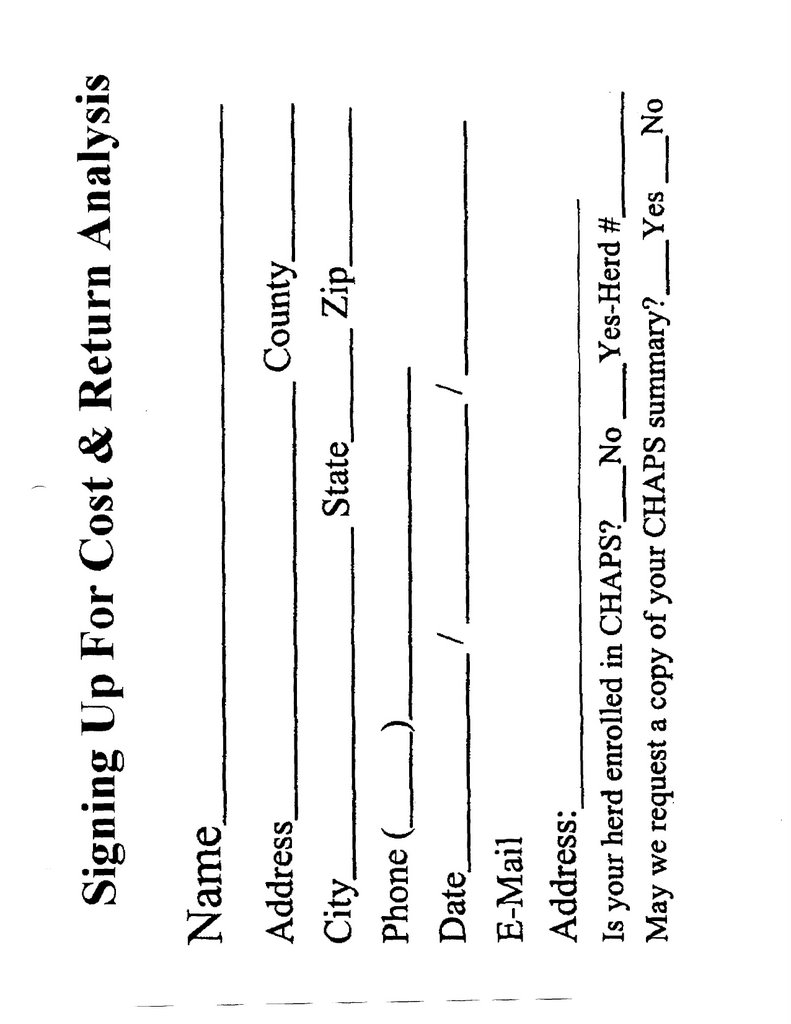
The two figures included here are an example completed input form that I use to calculate the costs of home-raised replacement heifers. I also included a blank input form that you can print out, complete, and send to me along with a $25 check and I will prepare a Cost analysis Of your Home-Raised Replacement Heifers.

To print out the example completed input form and the blank input form, double click on the figure and it will load a larger version into your computer. Then, use your browser's print command to print out a copy of the forms.

posted by Dr. Harlan Hughes 10:58 AM [edit]

Thursday, March 08, 2007

Cow Calf: Spring Compared To Summer Calving


The greatest nutrient demand of beef cows is during lactation. During lactation cows need to be fed high quality hay and, sometime, supplemented to meet the energy and protein requirements. In most Northern Plains locations, much like the sandhills of Nebraska, the primary grasses available for grazing are warm-season grasses that become available in late May to June. If cows calve in March, this means they are fed a lactation diet for about 90 days before summer grass. It has been documented that the highest quality in warm-season grasses in Nebraska occurs in late May to mid- June and gradually decreases.

Sequencing calving closer to the time when the grazed resource will meet the nutrient demands of the lactating female reduces feed costs and increase profit potential. Basically, this means moving "early spring" calving to "early summer" calving. Key components to changing calving time using a "systems" approach include: 1. Cows have access to vegetative forage for a short period of time prior to calving; 2. Cows meet their energy and protein needs from the pasture resource; 3. Hay and supplement costs are reduced because peak lactation now occurs when vegetative, high quality forage is available; 4. Reduced calf losses and sickness because calving occurs when the weather is warmer; 5. Less labor is needed at calving because calves weigh less at birth for June calving cows compared to February/March born calves; 6. Labor is reduced because less harvested feeds are fed; and 5. Different market alternatives are available for the calves and cull cows and bulls.

In 1993, a summer calving herd was developed at the University of Nebraska, Gudmundsen Sandhills Laboratory to compare spring and summer calving herds. In the spring herd, cows began calving in March and the breeding season began in June, and calves were weaned in October. For the summer calving herd, calving began in June, breeding season began in September, and weaning occurred in November or January. Data were collected in 1994, 1995, and 1996. Summer calving cows were fed 327 Ib of hay/cow/year compared to 3,947 Ib of hay/cow/year. Similar amounts of protein supplement were fed; summer calving cows were fed 154 Ib/cow/yr and for spring calving 96 Ib/cow/yr. The length of the grazing season went from 233 days to 357 days by adjusting the calving time from March to June. Cow reproductive performance was not different between groups. When calves were weaned at similar days of age, summer born calves were about 35 Ib lighter. However, January calf prices tend to be higher for the same weight of calf sold in October; therefore, summer-born calves generate similar gross income as spring-born calves. Due to costs savings in the summer calving system, primarily due to less labor and less hay fed, the summer calving system was a more profitable even at weaning time.

Some concerns with this summer calving system include breeding season occurring at a time when the temperatures are hot. In the sandhills of Nebraska, the temperature decreases at night and the humidity is low. In areas of the United States, because of high humidity and no night cooling, a breeding season that occurs during this time period could result in lower pregnancy rates.

Source: Dr. Rick Rasby, Professor of Animal Science, Animal Science, University of Nebraska - Lincoln, Lincoln, NE

posted by Dr. Harlan Hughes 7:50 PM [edit]

Monday, February 12, 2007

To access these articles, go to www.Beef-Mag.com, scroll down towards the bottom and click on "See more from Harlan Hughes" and this list will come up on your screen. Double click the article name to load that article into your computer. Use your browers's print command to print the article.

Good accounting Part III

Feb 1, 2007, by Harlan Hughes contributing editor
I suggested ranchers look to their on-ranch accounting systems to answer two key business-management questions...

Good accounting Part II

Jan 1, 2007, by Harlan Hughes, contributing editor
Last month, I summarized how some ranchers are being let down by their on-ranch accounting systems. This month, I'll focus on good accounting and how...

Bad accounting Part 1

Dec 1, 2006, by Harlan Hughes contributing editor
Today's ranch businesses are dramatically different from those of years ago. Previously, profit margins were such that the more beef you produced, the...

The perfect beef-cow-lease

Nov 1, 2006, by Harlan Hughes contributing editor
The 2002 and 2006 droughts have stoked interest in beef-cow leases, as drought-impacted ranchers seek to lease their cows to operators with grass and...

Planning prices revised upward

Oct 1, 2006, by Harlan Hughes contributing editor
Prices continue strong for cow-calf producers. As of late August, the 2006 drought has had little impact on cattle prices, and drought-induced early weaning...

What's a fair cow share lease?

Sep 1, 2006, by Harlan Hughes contributing editor
As the nation's drought expands and worsens, I get more calls on the economics of moving a cow herd to another ranch for feeding over the next year. Typically,...

Calculating gross income accurately

Aug 1, 2006, by Harlan Hughes contributing editor
Most ranchers don't accurately calculate the gross income of their beef cow herds. A correct economic analysis should be based on the accrual-adjusted...

UCOP will tell your story

Jul 1, 2006, by Harlan Hughes contributing editor
A statistical analysis of my Northern Plains 1990s beef cow Cost & Return Database suggests weaning weight explained only 20% of herd-to-herd variation...
Planning prices for future markets

Jun 1, 2006, by Harlan Hughes contributing editor
This article is the last in my series on how to make the cattle cycle work for you. Readers should now understand the 10- to 12-year cattle cycle and...
Weathering the cycle's end

May 1, 2006, by Harlan Hughes contributing editor
We know a typical cattle cycle lasts 10-12 years. We also know cattle inventory cycles are the fundamental factor behind beef-price cycles. Such random...
Today's strong bred cattle market

Apr 1, 2006, by Harlan Hughes contributing editor
The U.S. bred female market is very strong. In mid February, some 2-year-old Montana heifers sold for $1,650/head. Given that today's calf prices aren't...
4 winning market strategies Part V

Mar 1, 2006, by Harlan Hughes contributing editor
The key point in this five-article series has been that once a rancher believes in cattle cycles, he can make the cycle work for him. The net result is...
Working the Cycle-- Part IV

Feb 1, 2006, by Harlan Hughes contributing editor
This month, I'll share a management strategy ranchers can use in making the cattle cycle work for them. This is a strategy high-profit ranchers taught...
Working the cycle Part III

Jan 1, 2006, by Harlan Hughes contributing editor
In the November issue, we discussed the cattle cycle and its 10- to 12-year cyclical nature. I suggested that if a rancher fights the cattle cycle, it...
Cattle/beef price-cycle relationship Part II

Dec 1, 2005, by Harlan Hughes contributing editor
All experienced cattlemen know cattle prices go boom to bust and back again that's the cattle cycle. In fact, cattle and slaughter numbers, and cattle...
Working the cattle cycle Part I

Nov 1, 2005, by Harlan Hughes contributing editor
My lectures of the last decade have focused a lot on the cattle cycle and its resulting beef price cycle. My key message has been that if you fight the...
The economics of culling cows

Oct 1, 2005, by Harlan Hughes contributing editor
While most producers direct energy toward marketing steer calves, few do the same for marketing cull cows. Ten years of economic analyses for Northern...
Six steps to an optimal marketing plan

Sep 1, 2005, by Harlan Hughes contributing editor
By now, most of you are pondering marketing your 2005 calves. Thus, I'll share my most recent planning price projections and the management implications...
Cost control is in the details Part III

Aug 1, 2005, by Harlan Hughes contributing editor
Benchmarking is comparing your beef cow herd's production, financial and costs of production measures to those from a set of benchmark herds. Last month,...
What benchmarking can tell you

Jul 1, 2005, by Harlan Hughes contributing editor
Let's look at what benchmarking the act of comparing a beef cow herd's production and financial measures to those of a set of benchmark herds can tell...
Profiting on 2005 calves Part I

Jun 1, 2005, by Harlan Hughes contributing editor
Now is the time to think about generating the maximum possible profit from your 2005 calves. It begins by fully analyzing the production of your 2004...
The worst and best herds

May 1, 2005, by Harlan Hughes contributing editor
Managing a profit into beef cows without detailed management data is becoming increasingly difficult. Inflating production costs tend to negate much of...
Increasing your profits Part III

Apr 1, 2005, by Harlan Hughes contributing editor
With calving season upon us, I hope you're recording your calves' birth dates and their dam numbers in a calving book. If so, all you need to generate...
Increasing your profits Part II

Mar 1, 2005, by Harlan Hughes contributing editor
Record-high calf prices in 2004 should have generated record-high profits. Yet, only one out of my last six herds analyzed generated record profits. The...
Something's amiss with profit part 1

Feb 1, 2005, by Harlan Hughes contributing editor
As I continue to conduct cost and return analyses for U.S. beef cow producers, I see today's record calf prices aren't translating into record profits...


Dec 1, 2004, by Harlan Hughes contributing editor
Last month, I suggested that a fall 2004 preg-checked bred heifer that will produce seven consecutive calves has a calculated economic value of $1,560....
What's a bred heifer worth this fall?

Nov 1, 2004, by Harlan Hughes contributing editor
As more normal rainfall patterns return, ranchers will need to repopulate their herds. The good news: bringing bred heifers into your herd over the next...
Zap up your info system

Oct 1, 2004, by Harlan Hughes contributing editor
Beef cow producers are in the midst of exciting economic times. It's an excitement, however, that the industry experiences at this point in every cattle...
40 years of on-farm computing

Sep 1, 2004, by Harlan Hughes contributing editor
By focusing on the last 40 years of on-farm computing for farmers and ranchers, my goal is to stimulate ranchers to move from a traditional production...
Sell 2004 steers off grass

Aug 1, 2004, Harlan Hughes
As this piece was written in late June and early July, USDA had just announced two false-positive bovine spongiform encephalopathy (BSE) fast-test cases....
The money is in the details

Jul 1, 2004, Harlan Hughes
During the 1990s, I helped implement Integrated Resource Management (IRM) in the Northern Plains. Part of this consisted of going from kitchen table to...
Post-BSE market price tracking Part 1: Slaughter cattle prices

Apr 1, 2004, Harlan Hughes
Last month's Market Advisor column focused on the immediate market price impact of North America's second case of bovine spongiform encephalpathy (BSE)...
Post-BSE damage control strategies

Feb 1, 2004, Harlan Hughes
Damage control has to be uppermost in the minds of most ranchers in light of USDA's Dec. 23 announcement of a single case of bovine spongiform encephalopathy...
The story from up North

Jan 1, 2004, Harlan Hughes
May 20 and Aug. 8 of 2003 are well implanted in the minds of Canadian cattlemen. May 20 was the date the discovery of a single case of bovine spongiform...
How high and how long?

Nov 1, 2003, Harlan Hughes
As beef cow producers approach the weaning of their 2003 calves, market prices are at or near record levels. Two key questions are why are calf prices...
Good times are a'coming

Oct 1, 2003, Harlan Hughes
All indications are that several years of good economic times have returned to the cow-calf sector. Feeder cattle prices, driven by record-high slaughter...
Post-drought management Part III

Sep 1, 2003, Harlan Hughes
Managing a farm or ranch is never easy, but it's especially difficult during drought and its aftermath. Integrated business planning (IBP) can help you...
Managing the EZ-Way Part II

Aug 1, 2003, Harlan Hughes
A proper ranch management analysis must be based upon on-farm data specific to that ranch. It's from such data that long-term drought solutions and planning...
Managing post-drought, the EZ-Way

Jul 1, 2003, Harlan Hughes
Spring rains in cow country are turning many ranchers' attention toward drought recovery. For some drought-affected ranchers, that means repopulating...
For intensive managers, COOL will be a snap

Jun 1, 2003, Harlan Hughes
The country-of-origin labeling (COOL) law that takes effect Sept. 30, 2004 requires ranchers to verify the cattle they sell as born and raised in the...
Strong U.S. dollar works against U.S. producers

May 1, 2003, Harlan Hughes
This winter, I toured Brazil to visit with beef and soybean producers, and then spent several weeks in Canada visiting with Canadian beef producers. Upon...
Brazil, 33 years later

Apr 1, 2003, Harlan Hughes
In early February, my wife and I accompanied a farm and ranch tour of Brazil sponsored by BEEF and The Corn And Soybean Digest (formerly Soybean Digest)...
Look forward for price signals

Mar 1, 2003, Harlan Hughes
Today's roller-coaster cattle prices are largely attributable to extended drought in the western U.S. and western Canada, and the cattle cycle's delayed...
So Happy Together

Feb 28, 2003, By Harlan Hughes
Given rising carcass weights, increased production costs and unpredictable market prices, astute beef-cow producers are always searching for more efficient,...

Pasted from

Labels:


posted by Dr. Harlan Hughes 3:17 PM [edit]

Saturday, January 27, 2007

Don't Forget About the Benefits of Crossbreeding At Bull Buying Time

Greg Lardy, Extension Beef Cattle Specialist, NDSU Animal & Range Sciences Department

Commercial cattle producers are in the thick of poring over bull sale booksthis time of year. Don't miss the benefits of a well-planned crossbreedingprogram as you prepare to make bull purchases. Commercial producers shouldtake advantage of crossbreeding to improve productivity in their herds.

Crossbred cows are typically more productive, have greater fertility, and produceheavier calves than purebred cows. In addition, traits like longevity andadaptability are enhanced in a well-planned crossbreeding program.Data from the USDA-ARS Meat Animal Research Center (MARC) in ClayCenter, Nebraska, indicate that crossbred cows are 25 percent moreproductive than purebred cows. About two-thirds of this advantage comes fromthe crossbred cow while one-third comes from the crossbred calf.

Heterosis or hybrid vigor is the term used to describe the increase inproductivity when comparing the crossbred offspring to the purebred parents.Traits that improve the most from heterosis are fertility, adaptability, andlongevity.

Complementary traits in different breeds are another advantage ofcrossbreeding programs. Crossbreeding can provide a combination of traits inthe offspring that is superior to the parents. Using complementary traits can helpbring moderation to traits such as frame size, milk production and growthrate, making your cows better suited for a variety of production systems.

Many commercial producers have become disenchanted withcrossbreeding over the years. However, crossbreeding systems do not need tobe complex to accomplish desired objectives. A simple two-breed rotationalcross or a terminal sire program in which crossbred replacement femalesare purchased can simplify the systems and reduce the number of breedingpastures needed. A two-breed rotational cross will offer 67 percent of themaximum heterosis possible, while the terminal sire system will offer 100percent of the maximum heterosis possible.

Take the time to consider the benefits of a well-designed crossbreedingprogram before you make bull buying decisions. It will pay dividends for you inthe long run.

posted by Dr. Harlan Hughes 10:12 AM [edit]

Thursday, January 04, 2007

How To Sign Up For My Personalized IRMez Beef Cow Cost & Return Analysis All Done Via Email


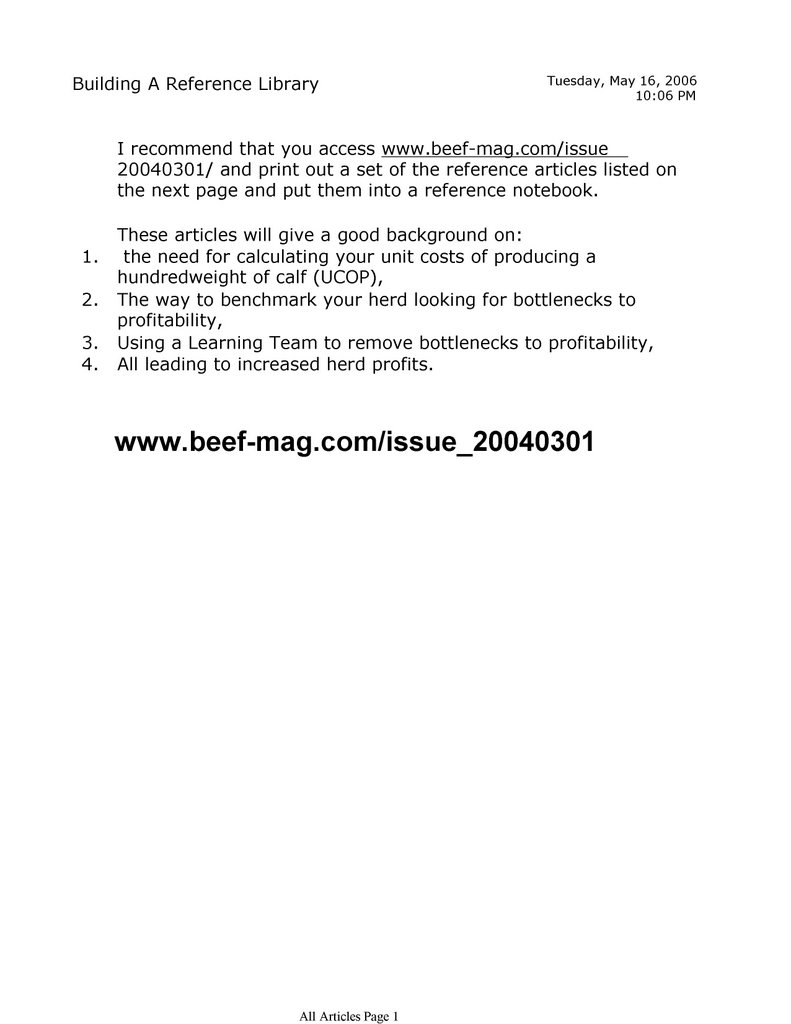
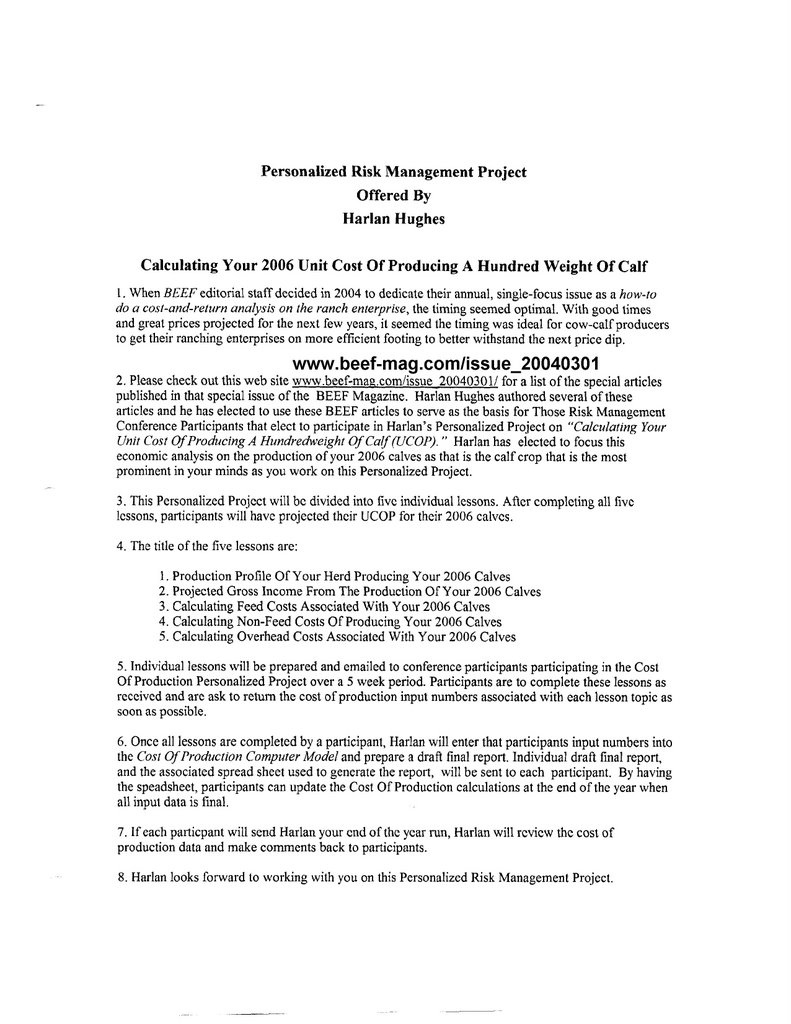
Introduction No 1: Here is Introduction No 1 of the "Calculate Your Own Personalized UCOP." Click each page and it will expand on your screen. Then, print the expanded page with your browser print command. Finally, assemble the pages according to page numbers.

posted by Dr. Harlan Hughes 12:17 PM [edit]

Wednesday, December 20, 2006

Heifer Development Costs

At the 2006 Cornbelt Cow-Calf Conference, Mike Kasten, a commercial producer from Missouri, who is a member of an alliance that sells bred heifers to other producers, outlined their costs of heifer development. Heifers are fed to gain 1.75 to 2.00 lbs per day from weaning to first breeding season in order to achieve optimal reproductive performance. Their costs could likely serve as a benchmark for other cow-calf producers in the Midwest. Following is a summary of their average costs.

Item Costs:
Grains (2550 lbs) $163.20,
Forage (pasture and hay) $66.66,
Veterinary and vaccines $11.48,
Breeding fees (semen and synchronizing) $32.87,
Clean-up bull $6.27,
Open heifer charge $18.27,
Interest on heifer $38.81, Interest on feed $5.11,
Labor $40.86, and
Sale expense $40.00.

Total variable costs $423.98.
Value of heifer at weaning $674.25.
Total all costs $1098.23.

As shown above, feed costs accounted for 54% of variable costs, which is slightly lower than for most cow-calf operations

(SOURCE: Proceedings, 35th Annual Cornbelt Cow-Calf Conf., Feb. 25, 2006, Pella, IA).

Source: Dr. Rick Rasby, Professor of Animal Science, Animal Science, University of Nebraska - Lincoln, Lincoln, NE

posted by Dr. Harlan Hughes 4:09 PM [edit]

Sunday, October 22, 2006

Fall 2006 Beef Outlook


by
Christ Hurt
Professor, Purdue University


Beef producers saw a dramatic outlook improvement on July 27th when the Japanese once again accepted imports of U.S. beef. While the news was not so dramatic, the price reaction to it was spectacular. Finished cattle prices rose from the high $70s in late July to near $90 by early September.

Beef supplies for the rest of 2006 and for 2007 are expected to be up about 2%. Beef cow numbers were up only .3% in July and milk cow numbers were up 1 %. The calf crop for 2006 is up only .3%. Thus, much of the 2% increase in beef supplies for 2007 will be from heavier weights.

Beef cow/calf operations are not indicating intentions to expand at this point since they have not increased the number of beef replacement heifers. Drought conditions from the Northern Plains to the Southern Plains also resulted in reduced herds from South Dakota to Texas this year. The dryness on the Plains provides an opportunity for the feed-rich Eastern Corn Belt producers to expand.

While exports have been opened to Japan, South Korea is still considering re-opening as of early September and total U.S. exports are expected to be slow to recover to their 2003 levels. Why? Japan, our largest beef buyer, largely replaced U.S. beef with other products including more beef from Australia and greater U.S. pork and broiler imports. Now, U.S. beef will have to "earn back" that business from other competitors.

This fall, finished steer prices are expected to be in the very high $80s to low $90s. A continuation of strong prices is expected in 2007 with first quarter prices averaging in the very low $90s and mid-to-higher $80 for the spring quarter.

Feeder cattle and calf prices should be near record highs this fall and winter. The record high quarterly price for 500 to 550 pound steer calves in Oklahoma City was $136 per hundredweight. Prices this fall are expected to be near those levels. Steer calves in Indiana and Kentucky are expected to be in the $120 to $130 range. Heifer calves may be $5 to $7 lower. These prices continue favorable profit levels for brood cow operations.

Prospects appear to be very good for cow/calf profitability again in 2007. Why? Exports should continue to build slowly; this year's small calf crop means modest increases in beef production next year; and if the Plains drought improves, more heifers will be retained for expansion.

In 2006, finished steer prices are expected to average about $86. For 2007 a new record high could be established, breaking the 2005 record of $87.18. However, rising corn prices may keep calf and feeder cattle from setting records also.

Indiana's major expansion of ethanol production will mean huge supplies of DDG's will become available in 2007. Production by late-2007 in the state will be about 1.7 million short tons. The abundance and low prices for this new feedstuff should stimulate interest in cattle feeding and dairy in the state.

posted by Dr. Harlan Hughes 2:26 PM [edit]


Corn Price Increasing

Corn prices this year have averaged above a year ago in response to a smaller corn crop and robust demand from the ethanol industry and rather strong exports. In late March, weekly corn prices for Omaha hit $2.00 per bushel and have generally continued on an upward price trend ever since. For the next few years, one of the biggest risks facing livestock producers will be feedstuff costs, especially corn.

Based on weekly data, for the first three quarters of this year Omaha corn prices averaged $2.04 per bushel compared to $1.81 last year, but about 3 percent below the 2000-2004 average. In mid-September corn prices weakened to $1 .94 per bushel and sparked some thoughts of relief in the cattle feeding and hog sectors for lower corn prices this fall. However, the following week, corn prices jumped to $2.20 per bushel, the largest week-to-week gain thus far this year and again to $2.38 per bushel by the end of the month. In early October, Omaha corn prices were over $2.40 per bushel. The last time, Omaha reported a higher weekly corn price was in mid-July of 2004.

Corn prices could moderate some this fall depending on the size of the 2006 corn crop. But, in the longer-term corn prices are expected to continue the upward trend mainly due to growing demand from the ethanol industry. Some industry forecasts call for cash corn prices to hit the $3.00 per bushel mark next year.

In recent weeks, feeder cattle and calf price declines have in large part been due to the upswing in corn prices. In LMIC calf and yearling price forecasts for 2007 and 2008, most of the forecasted declines in prices are a result of higher
corn prices. In fact, slaughter cattle prices will likely be rather flat compared to calf prices.

source: LMIC Denver,Co

posted by Dr. Harlan Hughes 5:55 AM [edit]

Sunday, September 03, 2006

Some Grain-Feeding Tips For Cows In A Drought


If drought is playing out your pasture, Rick Rasby, University of Nebraska beef specialist,
offers the following feeding and supplementation advice for those looking to feed corn:
In limit-feeding corn to cattle in drylot, be sure to allow plenty of bunk space to ensure all
cattle have the opportunity to feed (24-36 in./head, perhaps more with bigger cows).

The following ration recommendations are based on feeding situations where no pasture is
available. The concentrate part of the ration supplies the energy and protein needs, while a
low-quality forage ensures that rumen health isn't compromised.

If using a low-quality hay for the forage source, Rasby recommends including a supplement
with an ionophore calibrated to deliver 200-250 mg/head! day to each cow. The ionophore
will help reduce digestive problems and increase feed efficiency.

Because these rations are supplying all of cattle's daily nutrient requirements, Rasby
recommends feeding twice/day - mornings and evenings - for the first week, feed half of the
ration at each feeding to allow cows' rumens to adapt. After a week, it's likely more
economical to feed the ration once/day, he says.

If corn gluten feed or soy hulls are substituted for grain, an ionophore isn't necessary. The
corn gluten feed may be dry or wet, but account for the moisture if feeding wet product.
Corn gluten can replace corn or milo on a pound-for-pound basis, but be sure to account for
the product's moisture. Half the grain part of these rations could be replaced with soy hulls.

If using distillers grains, feed a maximum of 7 lbs./head/day on a dry matter basis. When
using gluten or distillers, phosphorus supplementation isn't needed; if fed instead of corn, a
protein supplement isn't necessary.

If feeding gluten or distillers, Rasby says a high-quality forage such as alfalfa isn't necessary.
When feeding whole corn, include 10-12 lbs.,/head/day on an as-fed basis, along with 2-2.5
lbs. of a 38% supplement (with ionophore), 6 lbs. of low-quality hay, and salt and mineral
free-choice, for a 18-20 lbs./head/day total ration.

For cows whose calves have been weaned, Rasby recommends 10-12 lbs. of whole
corn/head/day on as as-fed basis, with 2 lbs. of a 38% supplement, 6 lbs. of low-quality hay,
and salt and mineral free-choice, for a total ration of 16-18 lbs./head/day.

The low-quality hay can be any of last year's carry-over hay, but if the hay is very low
quality, protein will be needed. If 6-8 lbs./head/day of alfalfa is included in the whole-corn
diets, a protein supplement isn't needed.

Because the diets are limit-fed, it may take time for cows to adapt to the feeding program,
Rasby says, so add 3-4 lbs/head/day of a low-quality forage as a filler.

-- Rick Rasby, University of Nebraska-Lincoln animal science professor


posted by Dr. Harlan Hughes 7:37 PM [edit]

Early weaning a viable option during drought conditions

by Dr. Kris Ringwall

NDSU Extension Service

DICKINSON, N.D. - On Aug. 9, the North Dakota State University Dickinson Research Extension Center shipped its first load of early weaned calves to Scottsbluff, Neb. The day was hot, but not unbearable. The cows were put back to pasture after ultrasounding for pregnancy.

The cows were bred well. Only five cows of the 48 in the group were not detected as pregnant. That doesn't mean they were not pregnant; it simply means they could have been late and are under the detection age for ultrasounding. The other 43 cows were at least a month along in their pregnancy.

The bulls will be heading to town. All should break the ton mark for weight and hopefully will bring in the low- to mid-$60 range. Given the current competition for a bite of grass, the check should be good. The corrals will breathe a sigh of relief because they do not have to hold another set of bull re-acquaintance sessions.

Two-year study

The early weaning project is a two-year study involving 505 cow-calf pairs from the NDSU-DREC, South Dakota State University Antelope Research Station and the University of Wyoming Beef Unit. By now, the calves should be getting acclimated in their new home.

Doug Landblom, DREC animal scientist, is the lead author of the study, which reported first-year results in the 2006 NDSU-DREC annual report. Landblom and colleagues investigated many variables in the study.

The objective of the study was to evaluate the effects of mid-August weaning vs. more traditional early November weaning on cow and calf production traits, forage utilization and economic returns. The study revealed weaning calves early from spring-calving cows can have multiple impacts on beef systems.
The calves were penned relative to their individual weight and body condition score. In the study, calves were weaned either at an average of 140 days of age in August or at an average of 215 days of age in November. The mother cows grazed native range between the two weaning dates.

Calves from the North Dakota and South Dakota cow herds were finished in Nebraska, while the Wyoming calves were finished in Wyoming. Not all locations responded the same. For purposes of practical discussion, overall, the cows that had calves weaned in August lost less weight than the November-weaned cows. The Dakota cows' body condition score was improved for August-weaned cows vs. the November-weaned cows, but not for the Wyoming cows.

This study was especially appropriate this year because of the drought conditions that exist. Data collected in the first year of the study showed the quantity of forage that disappeared was reduced by more than 27 percent when calves were weaned in August.

Performance

During the backgrounding feedlot phase, the performance of August-weaned steers from North Dakota had greater average daily gain than the November-weaned calves. Both North Dakota and South Dakota steers were more feed efficient during backgrounding.
In the finishing phase, August-weaned steers grew slower, but were more efficient. On average, at all locations, November-weaned steers entered the feedlot heavier and required fewer days on feed to harvest, but August-weaned steers were 46 days younger at harvest.


Early weaning a viable option during drought conditions

Landblom and his associates concluded weaning spring-born calves early reduced forage utilization, improved cow body weight and body condition score, improved backgrounding performance and finishing feed efficiency, reduced the number of days from birth to harvest and yielded similar finishing performance.

The bottom line is don't be afraid to early wean calves. Make sure you get with a feedlot and nutritionist and do it right.


posted by Dr. Harlan Hughes 5:20 PM [edit]

Friday, August 11, 2006

Cow Market Pressure Likely to Increase
by Derrell S. Peel, Oklahoma State University


Cull slaughter and breeding cow prices are likely to come under more downward pressure in the coming weeks as drought forced sales continue. In the southern Plains it is not necessarily larger sales of cows that will increase the pressure on cow prices as increased cow culling has been the case all year. Region 6 beef cow slaughter is up 44 percent for the year to date. It is the additional of more cows from other regions combined with continued heavy cow sales in the Southern Plains that may push cull cow prices lower. Rapid deterioration of forage conditions in the central and northern plains and the southeast has added additional pressure to cull markets. On the positive side, the overall meat market situation is somewhat improved compared to the first half of the year, especially with respect to poultry supplies and that may firm up the hamburger market. Hopefully this will lessen the impact of additional supply pressure as a result of drought forced culling.


So far this year, beef cow slaughter in the region 6, that includes Oklahoma, Texas, Arkansas, Louisiana and New Mexico has been 422,100 head which is equivalent to 4.49 percent of January 1 beef cow inventories in these states. In 2005, beef cow slaughter at this point in the year was 293,400 head, a rate of 3.13 percent of January 1 beef cow inventories. This represents an increase of 1.37 percent in culling or an additional 128,700 head. This does not include any beef cows that have been relocated outside the region due to drought. Decreases in beef cow numbers in this region combined with additional culling in some other areas could well result in a decrease in beef cow inventories come January.


posted by Dr. Harlan Hughes 7:37 PM [edit]

Monday, July 31, 2006

Creep feeding considerations for your ranch

By Travis Maddock PhD

Ah summer. Cows are out grazing (or not, depending on where you live in The Cattle Business Weekly territory), haying has started (or not), and many ranchers are. getting out the creep feeders, preparing to put a little extra pay weight on their calves or hoping to alleviate drought stress on their cows.

But the question often asked is does creep feeding pay? Of course it depends on a number of things like feed costs, conversion or gain efficiency, and market conditions. So let's explore the ups and downs of creep feeding.

Do the calves gain weight? And what is the cost? Over the years, a number of studies have looked at supplementing suckling calves, what we commonly call creep feeding.

A review of this literature summarized. 31 different research trials and found that creep feeding increased daily gains 0.2 to 0.5 lbs./day during the feeding period with an average of 0.4 lbs/Day. When convert-ed to a 90 day creep feeding period, this translates into an average 36 extra pounds at weaning. This is certainly a positive, especially to producers that market their calves at or shortly after weaning.

Efficiency is another question altogether. Gain efficiency is calculated as gain above control divided by creep feed intake (example creep fed calves that gained 0.25 lbs./day more than control and consumed 4 lbs. of creep feed would have a gain efficiency of 0.0625 (0.25/4=0.0625)).

Gain efficiencies found in existing literature ranged from 0.03 to 0.17, however the average for the literature reviewed was 0.11. This means that for every 100 lbs. of creep fed consumed, the calves gained an extra 11 lbs. The average intake of creep feed over all the trials evaluated was 3.6 1bs/day. The cost of creep feed can vary greatly. Commercial creep feeds can run any-where from $120 to $200/tan or . $0.06 to $0.10/lb. in the Northern Plains, depending on protein level, mineral addition, and medication added.

After inquiring with a couple of local producers and feed 'dealers, I settled on an average of $150/ton, or $0.075/lb. Consider this a run of the mill feed, 16% protein and most likely a mix of grain, either corn, barley, or oats; and some co-product, such as wheat midds or soy hulls. This feed would most likely have some sort of mineral mix included as well. Using the gain and efficiencies averages noted above, calculating cost and return is easy. The base numbers would look like this: average gain above non-creep of 0.4 lbs./day with an average intake of 3.6 lbs/day (a gain efficiency of 0.11) and an average cost of $150/ton or $0.075/lb .(this does not include labor, feed transportation, creep feeders, etc.). Over a 90 day feeding period, you could expect calves to gain an additional 361bs. (90 days 0.4 lbs./day = 36) and consume 324 lbs. of feed (90 days * 3.6 lbs/day = 324) at a cost of $24.30 (324 lbs. $0.075/lb = 24.30).

Does it pay?


Let's assume that non-creep fed calves would have an average weaning weight of 535 lbs. and calves creep fed would then wean off at 571 lbs. (very close to benchmark averages for Northern Plain's cowherds). Looking back to the first week of November, 2005, and the average weighted price (including both steers and heifers) for these weights in North Dakota were $126/cwt and $122 /cwt, for 535 and 571 lb. calves, respectively. This means the 535 lb. calves were worth $674 and the 571 lb. calves were worth $697, or a difference of $23.

If the gains and cost of feed were similar to the example above, the producer in this scenario would have lost $1.30 per calf creep feeding (the cost of the 36 lbs. was $24.30). And this didn't even include labor, cost of transporting feed, and other fixed and variable costs. Now keep in mind, that the numbers used to generate this return were averages and assumptions.
Producers should do their own math when determining if they should creep feed or not.

For What It is Worth


Creep feeding is one of those management tools that has pros and cons. The numbers above , especially feed costs, can be managed to make creep feeding appear more attractive. However, the truth of the matter is that the returns on investment generally is not very good, other than bragging right at the coffee shop about waning weights.

On the other hand, more research is under way on the effects of creep feeding, and probably more specifically, on creep feed composition and how this might improve feedlot performance and, probably more important, carcass composition. This may lead to new ideas and improved economics when it comes to utilizing creep feed in commercial cow herds.

====================================================================================
Travis Maddock is a native of North Dakota and a PhD graduate of Dakota State University. He owns and operates Cattle Concepts, a beef systems consulting business base in Fargo, ND.

Email at travis@cattleconcepts.com or ohone at 701-541 5533.

posted by Dr. Harlan Hughes 4:44 PM [edit]

Wednesday, July 26, 2006


Creep Feeding Economics


Questions about creep feeding calves tend to pop up during times of high prices and also during times of drought.
Creep feeding of calves can be of economic value during times of drought and reduced forages for the cows. Indications are that calves do substitute some creep feed for the grass they consume and also the creep fed calves may not draw down the milking cows as much.

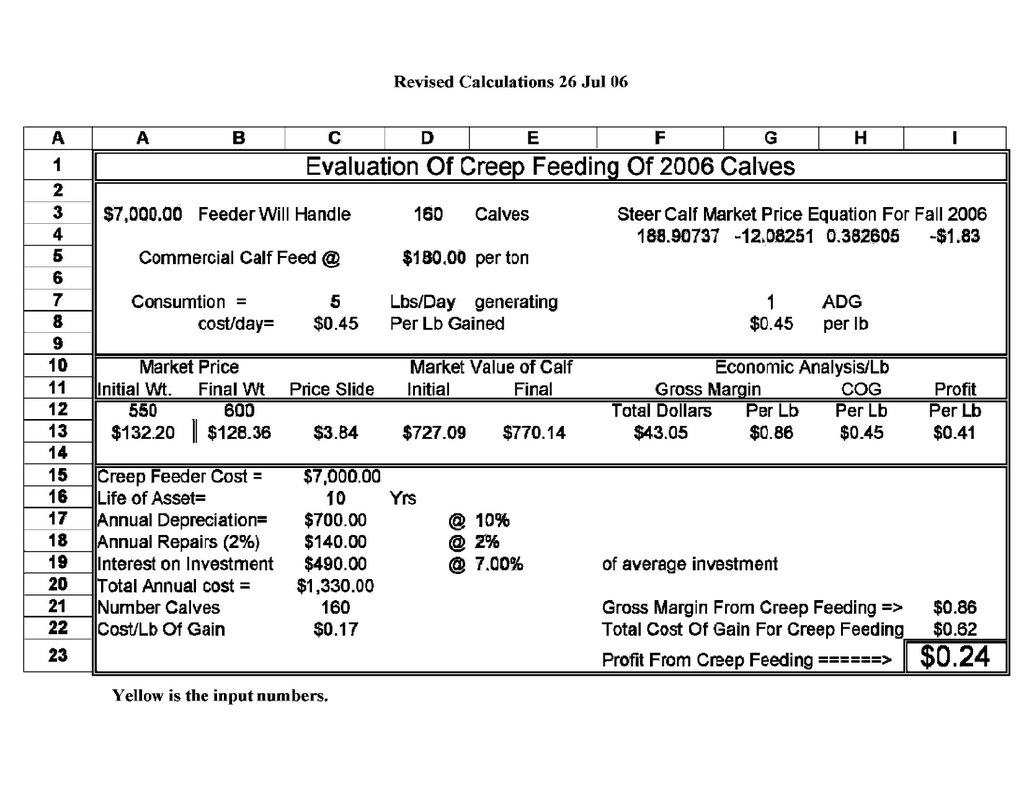
Creep feeding because of high calf prices is generally not recommend -- at least with expensive commercial creep feeds. The problem is that with high market prices of calves comes large price slides. For example, a 550 Ib. feeder calf at weaning 2006 is projected to sell for $132 per cwt. A 650 Ib. feeder calf is projected to sell for $124 for a price slide of $7.49. This means that all 650 lbs will sell for the reduced $124 per cwt. This calculates out, then, to a gross margin of $0.84 per Ib. gained from creeping.

If the creep feed cost less than $0.84 per lb, then creeping economics is favorable. If the creep feed costs more than $0.84 per lb, then the economics of creep feeding is not economical.
The rancher situation that triggered this creep feed analysis, said the commercial creep feed would cost $180 per ton and said that it would take 5 lbs per day and the average daily gain (ADG) was projected at 1.0 lbs per day.

After buying $7000 creep feeder to service 160 calves, the projected profit from creep feeding is a positive $0.24 per Ib. of gain from creeping. The detailed economic analysis for this creep feeding in presented in the table.

Given these numbers, I cautiously recommend that this rancher try creep feeding of his calves this year. The challenge in all of this will be to get the 5:1 feed conversion that was suggested by the feed salesman.

Harlan Hughes
Western Edge Consulting
701-238-9607
Harlan.hughes@gte.net

posted by Dr. Harlan Hughes 8:48 PM [edit]

Drought & Infertility - Find The Fertile Cattle & Sell the Rest


Several weeks ago, as bulls were going out to pasture, an absolute requirement was fertility. Bulls incapable of settling cows are useless and with the current feed shortage, compromise the system.

Likewise, cows that fail to settle are similar. Open cows' greatest value is salvage because they eat well, compete better and produce fat, which is not the desired product of a profitable and customer-orientated beef system.

Bulls that don't settle cows cost money. So do cows that are not bred to calve early. Feed is short; there is no use living in denial. There is no room in the pasture for infertile cattle.

Early detection of open or later-calving cows can be a potential group of cattle to cull. Cow Herd Appraisal Performance System (CHAPS) benchmarks indicate that 6.6 percent of the cow herd is typically open and 5.4 percent of the cows typically calve very late, which is defined as 63 days after the start of the calving season.

These two groups of cows account for 12 percent of the herd and would make a very logical cut today as pastures and feed start to look scarce. Another 8.2 percent of the cows calve between the 42nd and 63rd day of the calving season. This group of cows also could make a trip to town, with someone else's calving pasture the destination.

Heifers are another area to review. CHAPS data indicates that only 71 percent calve within 21 days and 85 percent calve within 42 days of the start of calving. This could be an area to review.

The bottom line is simple. Call your veterinarian and get that ultrasound date booked so you have an idea of your calving spread and can cull as feed supplies and performance dictate. Open and late-calving cows impact the bottom line the same as infertile bulls.’

Recently, a producer inquired where I came up with the $40 daily bull charge for each day a bull is infertile. The $40 value, calculated with a little cowboy arithmetic, is the CHAPS benchmark (Chaps2000.com, click on benchmarks) for calf average daily gain on pasture of 2.38 pounds per day times the percentage of cows cycling on any given day (assuming all the cows have an equal opportunity to cycle and breed) times 21 days (reflecting the days before another opportunity to breed if the opportunity is missed).

On any given day, 4.76 percent (1 day divided by 21 days) of the cows should be cycling. Therefore, if a bull is not fertile on that day, the opportunity to conceive the calf is lost. If a bull is in a pasture with 30 cows, 1.43 cows should be cycling each day. If the infertile bull misses the opportunity to sire 1.43 calves and loses 21 days of gain at 2.38 pounds per day, 71.47 pounds of calf is lost.

Going back to the CHAPS benchmarks, in reality, only 62.4 percent of the cows are cycling in the first 21 days. Given some rounding, roughly 70 pounds of calf is lost on 60 percent of the cows. At $1 per pound of calf over the long haul, the end number appears to be just more than $40 per day per infertile bull. Obviously, high market prices will inflate the number and the weight or timing of marketing also will impact the number, but that is where the cowboy math comes in.

On the other hand, $40 may by a month's worth of hay for a pregnant cow. There seems to be some regret in repeating notes, but infertility simply needs to be steered out of beef cattle management systems. During a drought is a good time to make the point. Hope this helps and gives producers some food for thought in tough times.

Source: Kris Ringwall, Beef Specialist NDSU Extension Service


posted by Dr. Harlan Hughes 1:35 PM [edit]

Monday, July 24, 2006


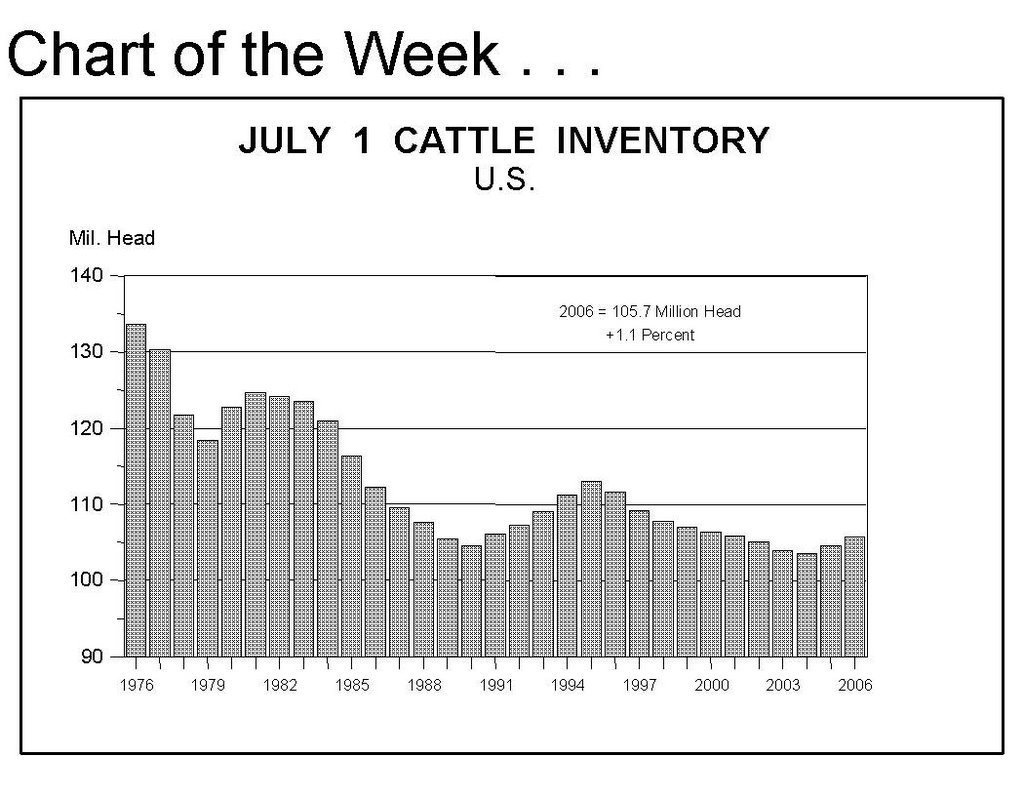
JULY 1 CATTLE INVENTORY SLIGHTLY ABOVE 2005's

On Friday, July 21s, , USDA-NASS released quite a few key reports, one of the most anticipated being the July 1 Cattle report. The report confirmed that drought conditions across much of the U.S. prompted a slowdown in the rate of increase of the cowherd. The total number of beef and dairy cows was very modestly above 2005's.

According to USDA, as of July 1St, all cattle and calves in the U.S. totaled 105.7 million head, 1.2 million head (or 1.1 percent) above a year ago and 2.2 percent over 2004's. The number of beef cows was reported at 33.9 million head, up less than half a percent from last year while the number of dairy cows at 9.2 million head was 1.1 percent larger. Of importance was the number of heifers 500 pounds and over held for beef replacements which totaled 5 million head, unchanged from the prior year and lower than the average industry expectation. However, dairy heifer replacements were nearly 3 percent higher than 2005's at 3.8 million head and 200 thousand head above 2004's. USDA reported the number of steers 500 pounds and heavier was 3.5 percent larger than a year ago.

The USDA estimated the 2006 U.S. calf crop at slightly above 2005's, however the year-to-year increase was smaller than expected given the larger cowherd on January 1 of this year. USDA reported the calf crop at 3.79 million head, 0.3 percent or 120 thousand head more than 2005's.

Source: LIvestock Monitor, Livestock Market Information Center, Denver, Co 24 July 06.

posted by Dr. Harlan Hughes 7:59 PM [edit]

Cattle Industry Faces Vulnerable Period

Cattle producers are continuing a slow expansion of brood cow numbers, but rapid movement of calves into feedlots due to depleted pastures means lower finished cattle prices are likely. Late 2006 and early 2007 remains a vulnerable period for the cattle industry as higher beef supplies are interfacing with delays in restoring beef exports to Asia. Slowing U.S. economic growth in the face of rising energy costs may also reduce beef expenditures.

The cattle expansion remains slow. In the mid-year Cattle report, USDA indicates that the total inventory was 105.7 million head, just 1 percent greater than last year at this time. The calf crop for 2006 is estimated at 37.9 million, fractionally higher than last year. The beef industry is in the second year of a brood cow expansion, but so far the growth is very moderate. Beef cow numbers reached a cycle low level in July 2004 at 33.4 million head. This summer’s inventory of 33.8 million head is just slightly over a 1 percent expansion in the past two years. So clearly, there is no rush to grow brood cow numbers. In addition, producers report they do not intend to increase cow numbers in the near future as they are retaining the same number of beef replacement heifers as last year. This means they are replacing cull cows, but are not likely to expand in the coming year.

So far this year, beef supplies have been up almost 7 percent on 4 percent higher slaughter numbers and 3 percent higher weights. Choice steer prices have averaged about $84.50, roughly $2.50 lower than during the same period in 2005. Overall, demand has held well this year with supplies 7 percent higher and prices only down 3 percent. Finished cattle prices will likely trade lower, into the higher $70s, for the end of the summer. Prices are expected to recover into the lower-to-mid-$80s by fall, with prices somewhat above the mid-$80s by the end of the year. For 2007, beef production is expected to be up 1 to 3 percent. While this year’s calf crop is estimated as only fractionally larger, weights will likely be up some next year, but not as much as this year due to higher feed costs and higher interest rates.

Feeder cattle and calf prices may feel some downward price pressure this fall and in 2007 as well. Calf prices this year have been only about $1 per hundredweight lower compared to the same period last year. Lower calf prices are expected to result from lower finished cattle prices, higher feed costs over the next year, and higher interest rates. Given an environment of slowing U.S. economic growth with high energy prices, this makes the rest of 2006 and early 2007 a vulnerable period for cattle finishers and adds new importance to getting “back on-track” with the Japanese.

Source: Chris Hurt, Extension Economist, Purdue University

Pasted from


posted by Dr. Harlan Hughes 4:48 PM [edit]

Wednesday, July 12, 2006

Japan retailers won't sell U.S. beef

Fewer than one in 10 Japanese restaurants and retailers plan to immediately stock U.S. beef once Japan resumes imports of U.S. product, according .to a survey by the Nihon Keizai Shimbun. Only 7.4 per-cent of businesses indicated they would immediately resume selling U.S. beef once it ships to Japan, probably in late July. (Do not hold your breath!)

Fifty percent of businesses said they had no plans to resume beef imports and some 30 per-cent said they would wait and see, depending on price, health concerns and other variables. Nihon Keizai Shimbun polled 60 major restaurants and retailers. By comparison, 60 percent of businesses polled in November said they would stock U.S. beef.

posted by Dr. Harlan Hughes 4:22 PM [edit]


Strong Planning Prices Projected For Cow-Calf Producers

Good news! My current Planning Price Projections (as of 30 Jun06) suggest that calf prices in the Fall of 2006 may equal or exceed fall 2005 prices! This is a change from my previous projections.

It looks like the 2006 drought in the southern region and the potential of drought in other regions has slowed the beef cow expansion that was projected as late as a few months ago. A slower national beef cow herd expansion suggests a slower price turn down in this cattle cycle.

The fact is that cull cow slaughter is up in the last few months suggesting that the beef cow build up has at least slowed.

Some other factors influencing these revised projections are:

1. We have considerable more bunk spaces than we had 10 years ago. These feedlots have two choices: 1) over-pay for feeder cattle or 2) let their bunk spaces go idle.

i. Most feedlot have considerable equity capital now so they are electing to over-pay for feeder cattle to ensure they use their bunk spaces.

ii. Someone, however, will not have feeder cattle to feed.

2. Corn prices are projected to be relatively low this year again leading to low cost of gain in the feedlot.

3. Calf-Feds placed 30 Jun 06 are projected to turn a slight profit. Yearlings placed 30 Jun are projected to loose money.

4. There is consider hype in the market again with respect to the Japanese market Just like in Dec05 thru Feb06.

i. I truly believe that this hype is misled but that is irrelevant if you are selling feeder cattle.

ii. Always remember with respect to hype. It can disappear just as fast as it appeared. Remember Mar and Apr 2006.

iii. Maybe one prices some calves now to lock in some of
these good calf prices.

If you have any comments or questions, please call me at 701-238-9607 or email at harlan.hughes@gte.net.

posted by Dr. Harlan Hughes 11:28 AM [edit]

Saturday, July 08, 2006

US Beef Sales May Fall Short Amid A Japan Border Reopening

KANSAS CITY (Dow Jones)--U.S. beef marketers and analysts say a trade deal with Japan that reopens its markets to U.S. beef products would be good for the U.S. industry, but the volume of sales probably wouldn't be large.

Trade sources who spoke with Dow Jones said consumer demand has shifted since Japanese officials halted further U.S. beef imports in January after a shipment of veal was found with spinal bone pieces attatched. Surveys show a significant percentage of consumers no longer want U.S. beef, and winning the market back will take time and effort, the said.

Even the U.S. Meat Export Federation, the organization devoted to marketing U.S. meat products abroad, has modest hopes.

Assuming the first shipments leave U.S. shores on Aug. 1, USMEF economists project only 25,000 to 30,000 metric tons of product will ship in 2006, said Cheryl Kamenski, manager of media communications for the USMEF.
For comparison, a chart on the USMEF Web site lists U.S. beef and beef variety meat exports to Japan in 2002 at 332,204 metric tons, with a value of $1.028 billion.

Kamenski said the products sold initially are likely to be a mix of beef variety meats destined for retail sale and steak products going to the restaurant trade.

The USMEF is keeping its estimate of initial beef trade low because Japan has said it planned to inspect every box of U.S. product it imports to make sure it all meets the trade-agreement guidelines, and the added cost could discourage trade, Kamenski said.

Source: Lester Aldrich, Dow Jones Newswires; 913-322-5179; lester.aldrich@dowjones.com

Pasted from


posted by Dr. Harlan Hughes 10:57 AM [edit]

Wednesday, July 05, 2006

Economics Of Drought Management Strategies

Major editorial correction made in the recommended drought strategies at the end.

July 05, 2006

Ranchers in the dry regions of the West are starting to ask questions about the economics of drought strategies. I have now conducted considerable simulation work on the economic impact of alternative drought management strategies for the potential 2006 drought coupled in with the past 2002 drought. I think My conclusions may well surprise ranchers!

I now have now developed the tools to look at the economics of alternative drought management strategies applied to specific individual ranches.

I recommend that ranchers separate de-stocking decisions from de-populating decisions. One decision is to remove cows from the grasslands and other decision is to remove cows from ranch ownership. De-stocking is a production decision and de-populating is an economic decision -- each with its own and distinct management decision variables. These are two distinct and different management decisions!

There are three added economic costs associated with a drought that can be broken down into visible and invisible drought costs. First is the selling of breeding females at fire-sale prices which is the visible drought cost. Buying back or raising added replacements after the drought is a second visible drought cost.

Having less calves to sell in years following the de-population is an invisible (hidden cost) --sometimes a huge hidden cost. In many cases, the invisible costs exceeds the visible costs.

Second, I suggest that optimal drought strategies vary with where we are in the cattle cycle. When calf prices are high, you have several drought strategies possible. When calf prices are low, about the only strategy available is to sell cows.

In the drought of 2002, we had low calf prices and low fire-sale prices for bred cows and high replacement prices after the drought. In the drought of 2006 we currently have high calf prices, projected higher fire-sale prices for bred cows, and projected lower replacement prices after the drought. The optimal drought strategy for 2006 probably is not the same as the optimal drought strategy for 2002. Be careful using your 2002 experience in formulating your 2006 drought strategy.

I am simulating two different drought strategies -- 1) selling off 30% of the females to reduce grass demand and 2) buying feed and keeping the original cow herd in place. I am currently looking at the compounding economic impact of the 2002 drought and now a 2006 drought projected over the total decade for the years 2000-2009.

As a general comment, the drought of 2002 and drought 2006 are projected to reduce the 10-year total net cashflow on my case ranch by 43%!

Major Editorial Correction entered in the next two paragraphs 15 Aug 06 !!

My simulations suggest that buying feed and keeping the cow herd in place in the 2002 drought so that one could continue selling full production of calves produced during the high-priced phase of the cattle cycle reduces the dollar impact of the drought substantially over the more traditional drought strategy of de-populating some of the herd in 2002. It is the record calf prices in 2003, 2004, and 2005 that made this difference.

My simulations also suggess that given the high firesale prices of breeding females, at least so far into 2006, that it makes more economic sense to de-populate the beef cow herd in the 2006 drought and then re-populate the herd back in 2 to 4 years down the road when bred females are projected to be lower priced. This is just the opposite strategy as was suggested for the 2002 drought.

My simulation work suggests that the drought management strategy that you pick is all critical!

Harlan Hughes
Professor Emeritus
North Dakota State University

harlan.hughes@gte.net
ph: 701-238-9607


posted by Dr. Harlan Hughes 10:58 AM [edit]

Friday, June 30, 2006

US cattle prices not expected to increase
Thursday, 29/06/2006

US Agriculture Department officials say it will take years to recover from
Japan's mad cow-related ban on beef and producers there should not expect to
see massive price rises.

US Agriculture Department livestock analyst Ron Gustafson says Japan's
expected reopening of its market to US beef after it completes audits of US
plants next month, will not bring a huge upswing in US cattle prices.

Mr Gustafson says it will take years to sell pre-mad cow amounts of US beef
to Japan, which only buys certain cuts anyway.

"We don't sell whole carcasses to the Japanese or South Koreans, or anyone
we sell cuts that, largely, we don't have the large demand for here in the US -
short ribs, plates and so-forth - the fattier items," he said.

Beef trade is likely to come up in meetings in the US this week between
President George W Bush and Prime Minister Junichiro Koizumi, since Japan
has not yet set a specific date to resume imports.

Source: National Rural News
http://www.abc.net.au/rura1/news/content/2006/s1674675.htm 6/30/2006


posted by Dr. Harlan Hughes 9:51 AM [edit]

Tuesday, June 13, 2006

COW SLAUGHTER UPDATE

Federally Inspected (FI) cow slaughter in 2006 has generally been above a year ago due to an upswing in beef cow slaughter, which in turn has pressured cull cow prices in recent weeks. This year, year-to-year increases in beef cow slaughter have mostly been due to dry conditions in the Southern Plains and southeastern regions of the U.S. Still, from a national perspective cow slaughter levels do not yet indicate a reduction in the beef cowherd.

Source: Livestock Market Information Project Web Page, 13 Jun 06.


posted by Dr. Harlan Hughes 9:00 AM [edit]

Monday, June 12, 2006

Welcome To The Special BEEF Cow-Calf, Spring 2004 Issue


14 Articles On How Ranchers Can Increase Their Beef Cow Herd's Economic Efficiency

You can access each article by clicking on its respective hot button

Welcome to the Spring 2004 Cow-Calf issue
Mar 1, 2004 12:00 PM
When BEEF editorial staff decided last fall to dedicate this annual, single-focus issue as a how-to on doing a cost-and-return analysis on the ranch enterprise,...

Bump Up Your Economic Efficiency
Mar 1, 2004 12:00 PM, By Harlan Hughes, PhD
In light of the discovery of the first case of bovine spongiform encephalopathy (BSE) in the U.S., damage control has to be foremost on ranchers' minds....

The 4 Major Components
Mar 1, 2004 12:00 PM, By Harlan Hughes, PhD
As market prices adjust post-BSE to an uncertain supply-demand equilibrium, ranchers will be unable to do much about their market prices. What they can...

The Importance Of UCOP
Mar 1, 2004 12:00 PM, By Harlan Hughes, PhD
Beef producers traditionally have focused their beef cow management attention on physical production traits. Typically, this has meant that weaning weights...

A Look At Analysis Tools
Mar 1, 2004 12:00 PM, By Stephanie Veldman & Joe Roybal
After making the decision to do a cost-and-return analysis (CRA) on your ranch, the next step is using an analysis tool to determine the production and...

Managing For Better Or Worse
Mar 1, 2004 12:00 PM, By Harlan Hughes, PhD
During the last decade, my high-profit Integrated Resource Management (IRM) cooperators demonstrated that the herds that best survive the market's volatile...

Building Learning Teams
Mar 1, 2004 12:00 PM, By Harlan Hughes, PhD
Beef farmers and ranchers often find it overwhelming to synthesize all the production and financial information necessary for profitability. An Integrated...

Going Head To Head
Mar 1, 2004 12:00 PM, By Harlan Hughes, PhD
A comparative analysis is the single, most powerful, farm and ranch management tool available. It's a tool that works especially well as a way to identify...

Team Management
Mar 1, 2004 12:00 PM, By Clint Peck Senior Editor
As cattle operations grow and become more complicated, ranchers admit they're often not very sure of their overall financial direction until it's too...

Net Return Is In The Details
Mar 1, 2004 12:00 PM, By Wes Ishmael Contributing Editor
Increasing the net profitability of a cow-calf operation is simple on paper. Just reduce production costs, increase pounds sold, increase the price received...

Mentors And More
Mar 1, 2004 12:00 PM, By Clint Peck Senior Editor
For several years, Brian Rosencrans, Powers Lake, ND, was a participant in the Integrated Resource Management (IRM) program offered through North Dakota...

Knowing is Growing
Mar 1, 2004 12:00 PM, By Wes Ishmael Contributing Editor
Asking and answering tough economic questions in a ranching operation isn't pleasant or easy. Just ask Mike Kelly. The first time he was out, we about...

Benchmarking An Example Herd
Mar 1, 2004 12:00 PM, By Harlan Hughes, PhD
Many ranchers feel the end product of an Integrated Resource Management (IRM) analysis is building a set of financial, economic and cash-flow numbers...

10 Years Of IRM
Mar 1, 2004 12:00 PM, By Harlan Hughes
Here are some of the lessons North Dakota learned after a decade of Integrated Resource Management (IRM) participation. Ten years ago, I promised North...


posted by Dr. Harlan Hughes 9:21 PM [edit]


Trends ... RED INK FOR CATTLE FEEDERS

The spring feeding season has been a difficult one for cattle feeders as high feeder cattle prices combined with above year ago feed grain prices and lower fed cattle prices left returns deep in the red. Red ink will continue on summer closeouts.

Since February, most slaughter steers sold lost money, with the largest losses incurred in the month of May. Based on the placement of a 750-pound steer in a Southern Plains commercial feedlot and taking into account all production costs, the estimated closeout return in May was just over a negative $153 per steer.

Two fundamental factors combined to cause large losses for May closeouts: 1) declining slaughter cattle prices, which fell below $80 per cwt. for the first time since February 2004; and 2) rather high feeder cattle prices.

Feeding-out steer calves placed into feedlots last fall also has been a red ink proposition, recently. In fact, the price ($ per cwt.) relationship between a slaughter steer price in May and a calf (500-to 600-pound steer) price the prior November was the lowest on record.

USDA began reporting western Kansas slaughter steer prices at feedlots in the early 1970's. In the last 30 years, on average the May slaughter steer price was about 90 percent of the calf price. Over the last 20 years, the "sell versus buy margin" averaged about 85 percent. Only three times in the last 30 years was that percentage under 75 percent. This year, the "sell/buy" margin at 62 percent was impossible to overcome.

Breakevens for a 750-pound steer placed into a Southern Plains feedlot during May is estimated to be about $87.00 per cwt., well above forecasted fed cattle prices for late this summer (i.e. September).

Breakeven sale prices for slaughter steers this summer and fall are below a year ago due to lower feeder cattle prices. Still, the next opportunity for positive cash cattle feeding closeouts will likely be during the fall (e.g. November or December).

Source: Livestock Monitor, Livestock Market Information Center, 10 Jun 2006

posted by Dr. Harlan Hughes 3:31 PM [edit]

Saturday, May 27, 2006


US COW SLAUGHTER UP 3%

US cow slaughter to May 6 is up 3.2% compared to 2005. The dry fall and winter in many of the southern states has lead to a recent increase in US cow slaughter.

March and April's levels were up 13% and 17% respectively. For the year. the current forecast is looking at a 9% increase over 2005 which would put 2006's total near 5.3 million head, still one of the smallest cow kills in history. The 2005 cow kill at 4.86 million was the smallest in recent times.

The drought conditions through the remainder of 2006 will play a key role in how many more beef cows come to town as culls. Cull prices have been about $5.00-7.00/cwt lower than last year and are expected to stay that way. Utility cow prices are between $50.00-52.00/cwt currently compared to $60.00 at this time last year.

-AD at CanFax, Canada.

posted by Dr. Harlan Hughes 1:46 PM [edit]

The Fed Cattle Summer Market Doldrums Started Early

By Derrell S. Peel, OSU Extension Livestock Marketing Specialist

Fed cattle markets have been disappointing in many ways in the first half of the year and that has many folks wondering what lies ahead for the rest of 2006. Fed cattle prices began the year strong off of the late 2005 rally but moved counterseasonally lower in the first quarter of the year. More recently, fed prices have stabilized somewhat but at lower levels than anticipated for this time of year. Summer is usually the seasonally low price time of the year for fed cattle and the question now is “How low will fed prices drop for the summer lows?” More fundamentally, why have fed cattle markets struggled so severely so far this year? Fed prices are struggling because of a complex set of supply and demand issues.

Supply issues have changed, more as a matter of timing than of a fundamentally larger supply potential. On January 1, 2006, feedlot inventories were already 3 percent above year earlier levels as aggressive feedlot demand and dry winter conditions combined to increase feedlot placements. Severe drought conditions in the southern winter grazing regions pushed many additional cattle to market ahead of schedule in January, February and March. These early placements, combined with a steady flow of Canadian feeder cattle pushed feedlot inventories to a record May 1 level that was 9 percent above the 2005 level.

The fed market psychology seems crushed under the idea that huge cattle inventories will weigh down the market for the rest of the year. It is important to remember that we don’t have anything near 9 percent more total feeder cattle available to push up feedlot production. On January 1 the estimated feeder supply in the U.S. was up less than 2 percent over the previous year. Allowing for a full year of Canadian feeder cattle imports in 2006, the potential annual feedlot production potential is perhaps a 3 to 4 percent increase over last year.

Feedlot placements were lower in April and will be lower still in May. Feedlot inventories will stay above year ago levels but will pull back significantly in the next couple of months. Exactly how far inventories will pull back will depend on forage conditions this summer as it affects the aggressiveness of heifer retention and on the rate of feedlot marketings. Total U.S. beef production is expected to increase about 5 percent, mostly as a result of more Canadian cattle being slaughtered in the U.S. Net U.S. beef supply is projected to increase less than 2 percent as increased imports of Canadian cattle are offset by reduced imports of boxed beef from Canada.

The other side of the supply increase has been extremely heavy carcass weights through the first half of the year. Cattle performance was good through the winter and feedlots have not had much incentive market cattle aggressively until recently. Through most of the first half of the year, heavy carcass weights added the equivalent of 15 to 20 thousand head per week to slaughter totals. Although carcass weights will likely remain above year ago levels, weights have moderated and there is significantly less incentive now compared to the last several months to increase fed cattle weights with higher feed costs and summer discounts on Live Cattle futures.

In the first quarter of 2006, demand limitations were a significant constraint to fed cattle prices. Boxed beef prices were limited by short run demand factors including increased competing meat supplies and higher energy prices. Tight meat packing margins resulted in intense pressure to limit fed cattle prices during this period. Moving into the second quarter, the supply pressures shifted the advantage to packers and fed cattle prices continued to weaken despite more stable boxed beef prices. At the current time, packing margins are much improved thereby reducing pressure on fed cattle prices while many feedlots continue to experience losses. Fed cattle prices are likely to remain in the $70s with an average summer low of roughly $75/cwt. expected. Feedlots are likely to continue to experience poor profitability through the third quarter of 2006.

There is reasonable hope for an improved fed cattle market situation in the last part of the year. Much of the current bulge of feedlot cattle will work their through feedlots in the third quarter of the year and supply conditions are expected to improve late in the year. Likewise, some of the competing meats issues will also improve in the second half of the year. Some of the demand uncertainties will remain, especially energy price impacts and potential impacts of Avian Flu in global meat markets. If these uncertainties do not actually manifest themselves as significant issues, it is likely that fed cattle prices are expected to recover back above the $80 level and could end the year in the mid $80s.

Oklahoma State University, in compliance with Title VI and VII of the Civil Rights Act of 1964, Executive Order 11246 as amended, Title IX of the Education Amendments of 1972, Americans with Disabilities Act of 1990, and other federal laws and regulations, does not discriminate on the basis of race, color, national origin, sex, age, religion, disability, or status as a veteran in any of its policies, practices or procedures. This includes but is not limited to admissions, employment, financial aid, and educational services.

posted by Dr. Harlan Hughes 10:19 AM [edit]

One calving season versus two calving seasons

By Glenn Selk, OSU Extension Cattle Reproduction Specialist

Deciding on the use of one calving season or two calving seasons is a big first decision when producers are choosing calving seasons. Many fall calving seasons have arisen from elongated spring seasons. Two calving seasons fits best for herds with more than 80 cows. To take full advantage of the economies of scale, a ranch needs to produce at least 10 to 20 steer calves in the same season to realize the price advantage associated with increased lot size. Therefore having forty cows in each season as a minimum seems to make some sense.

Using two seasons instead of just one can reduce bull costs a great deal. Properly developed and cared-for bulls can be used in both the fall and the spring, therefore reducing the bull battery by half. Another small advantage to having two calving seasons is the capability of taking fall-born heifers and holding them another few months to go in to the spring season and visa versa. Because of this replacement heifers are always 2 1/2 years at first calving instead of 2 years old. These heifers should be more likely to breed early in the breeding season and have slightly less calving difficulty. Research has shown that these differences are very small, therefore the cost of the other six months feed must be minimal to make this a paying proposition. Many producers like the dual calving seasons because of the spread of the marketing risk. Having half of the calf crop sold at two different times allows for some smoothing of the cattle cycle roller coaster ride.

There are however a couple of disadvantages that must be considered. The producer now has twice as many nights to get up and check cows and heifers at calving time. In addition, if heifers are not bred until about 20 or 21 months of age, then they will be more than 24 months of age when they are preg checked. Open heifers that need to be culled at more than 24 months of age will definitely be penalized at the market place compared to younger cull heifers that are sold at much higher prices per pound.

From the Oklahoma Cooperative Extension Service


posted by Dr. Harlan Hughes 10:17 AM [edit]

Wednesday, May 17, 2006


Comments On The Corn Market

In our May 12 edition of the DLR we briefly noted the latest USDA projections of corn supply and demand conditions for the upcoming marketing year. This was the first USDA assessment of the corn market for next year, and, naturally, much will depend on weather, conditions over, the summer months.

Depending on how yields shape up, one can make an argument that could send either bulls or bears house happy. Either way. this year's corn harvest is likely to be one of the most significant for the meat industry.

While feed costs have always been a significant driver of meat supplies. This year, more than any other time in history, we have a wild card that could wildly skew the demand side of the equation. That wild card is ethanol production in the US.

For those that have not looked at sugar futures in recent months, take a quick peek and see the impact that ethanol production in Brazil is having on world sugar, supplies. The rise in energy prices is pushing an increasing amount of agricultural products into the energy market -- be this in the form of grain or sugar cane ethanol or soybean based bio-diesel.

What does the latest USDA report suggest for corn supplies and prices in the upcoming year? Far starters, gone is the advantage of large starting corn stocks. While we are expected to inherit more than 2.2 billion bushels of corn front the 2005/06 marketing year, the decline in production is expected to be large enough that overall supplies during 2006/07 are projected to actually be down 3.4'% compared to the previous year. Overall production is expected to be 5.1% lower as a result of farmers planting 5.7'% fewer corn acres.


Yields on the other' hand are expected to be 0.7% higher. a projection based on the linear trend for corn yields since 1960. A 2% decline in yields from a year, ago would cause ending stocks for the year to be 850 million bushels, and the corn stocks to usage ratio would drop to just 7% –- one of the lowest ever. At such levels. it is conceivable that corn prices could go past the $4 per bushel mark in order, to ration available supplies.

A 2% increase in yields from a year ago would cause ending stocks to be somewhat larger than the current USDA estimate of 149 bu./acre but those stocks would still be 42% lower than during 2005/06.

Bottom line is that given the sharp decline in corn acres, the only way corn prices will hold any-where close to where they were in 2005/06 would be if corn yields approach the 160 bu/acre we saw two years ago. A divergence below trend, would be a real cause for concern if you are a cattle or hog producer.

Source: CME Newletter 17 May 06.


posted by Dr. Harlan Hughes 3:56 PM [edit]

Sunday, May 14, 2006

Natural Beef: Could your cattle qualify?

Among the growing popularity of branded beef programs, brands labeled "natural" are also coming of age. So what does the buzz-word "natural" truly mean, and what's the future for the natural niche?

Turk Stovall, with the Montana-based integrated beef genetics company ORIgen and formerly with North Platte Feeders in Nebraska, says, "Natural beef is moving from niche to mainstream. I really believe we are at the dawn of natural programs exploding. The industry is sending signals for international and domestic growth."

As an example, he reports that last year one-third of the cattle on feed at North Platte Feeders -- about 43,000 head -- were associated with natural programs.

With the increased demand, high premiums are being paid for cattle that qualify for natural programs, according to Stovall. "Natural beef companies are fighting for supply at different times of year and, as a result, premiums are being paid for all classes," he says. Stovall reports seeing premiums for natural cattle from $5-15/cwt. at the public auction, on the video market and for private sales.

What does natural mean?
By USDA's definition, natural simply means unprocessed. However, Stovall says the marketplace has adopted a "never-ever" standard for natural meats. This requires that cattle have never-ever been administered hormones or antibiotics from birth to harvest.

However, Stovall emphasizes that vaccines are not antibiotics, and says they are essential for natural programs because they help maintain calf health -- which would reduce the need for antibiotic treatment of sick calves.

Based on that definition, Stovall says any producer has the ability to produce natural cattle. In fact, he says, "Many ranchers already produce natural beef, but simply don't market them as such."

He says the key to raising and marketing natural cattle is the ability to keep records on the calves and identify any that have been treated with antibiotics due to sickness. Once an animal is treated, they no longer qualify for natural programs.

If you are willing to follow the production practices and keep the records to verify natural production, Stovall says producers should then cultivate a relationship with buyers or feeders to help secure a premium for their natural cattle.

"The No. 1 influencer of feeder calf premiums for natural programs is health management and assessment, and ranchers set the pace on this," Stovall says. Regarding feeder calves destined for natural programs, he says feeders want calves that have been preconditioned and backgrounded for 45 days after weaning. "No one can wean or background a calf better than the rancher himself," he adds.

Lastly, Stovall says reputation of the ranch is critical for building on natural programs in the future. "Feeders want a ranch they trust so they know the cattle are truly natural and all vaccinated to reduce health risks. At no time will a yard misrepresent themselves to a packer," he says.

He concludes, "If you can minimize that risk with your management at the ranch and create confidence and a good reputation for your calves, you'll be rewarded."

Producers who follow the proper protocols can identify their calves as "natural" through the Pfizer SelectVAC program. For more information visit www.selectvac.com.

Source: BEEF Quality Strategies [beef-mag@pbinews.com] 27 Apr 06


posted by Dr. Harlan Hughes 10:34 AM [edit]

Friday, May 12, 2006

U.S. Cow Costs Increased By $36/Head In 2005

Cattle-Fax(R) says its 2005 cow-calf survey revealed cash costs/cow averaged $351 in 2005 - $36/head more than the 2004 average of $315/head. In the past decade, annual cow costs have ranged from $292 to $351/head, with a 10-year average of $307/head.

Cattle-Fax analysts attribute the increase largely to higher energy and fuel costs. The costs cited above don't include depreciation, opportunity cost or returns to management.

Overall, 96% of producers selling weaned calves were profitable in 2005, a record-high percentage, Cattle-Fax says. Of producers selling calves at weaning, 80% made a profit of $100/head or more, 44% made $150/head or more, and only 4% were not profitable.

The results show a strong correlation between high-return producers and lower costs and higher production performance. Average cow cost for those profiting $100/head or more was $347. Those who profited less than $100/head had an average cow cost of $377/head.

The average cow cost for the low ? (least cost) of producers was $267/head compared to the high ? (highest cost) of producers was $445, a $178/head difference. The results also show a positive correlation between weaning percentage and profitability. Producers who made more than $150/head, weaned 4% more calves than those who broke even or lost money.

The survey also found 79% of producers use the Internet, 53% have registered a premise ID, 84% precondition their calves, and 78% felt the market rewarded them for preconditioning.

-- Tod Kalous, Cattle-Fax(R) Update, taken from the Michigan State University Beef Cattle Research Update

Source: BEEF Cow-Calf Weekly, 12 May 2006

posted by Dr. Harlan Hughes 4:23 PM [edit]

Friday, May 05, 2006

World Meat Congress Takes Stock Of Global Trends

If there was a common thread running through the World Meat Congress last week in Brisbane, Australia, it wrapped around three evolving consumer demands -- transparency, traceability and trust.

"We've never seen global competition for meat protein markets this intense," says Patrick "Paddy" Moore of Dublin, Ireland, chairman of the International Meat Secretariate (IMS). "And let me tell you, we haven't seen anything yet."

Brazilian Marcos Fava Neves, University of São Paulo professor of food marketing strategy, wonders why livestock traceability isn't being adopted in some areas of the world.

"Traceability is the non-negotiable foundation of trust," he says. "Without traceability, how can you be held accountable for what you produce? How else can you be rewarded for what you produce?"

Following is a snapshot of the "meat situation" in some selected countries:
In an extraordinary move earlier this year, Argentine president Nestor Kirchner increased federal taxes on beef exports and cancelled rebates of other taxes. His move, which infuriated Argentine producers, was aimed at rising inflation and escalating food prices. The target was the beef purveyor diverting beef supplies from the domestic market to meet export demand.


Demand from Australian beef in the North Pacific Rim skyrocketed followed the discovery of BSE in North America. David Bailey, economist with the Australian Bureau of Agricultural and Resource Economics, says his country's new animal traceability program has been critical in gaining market share in Japan.

While Brazilian cattle numbers increased dramatically the past decade, Brazilian consultant José Puoli says herd growth shows signs of slowing -- possibly retracting -- as profitability in the cattle sector diminishes. He points to intensifying competition for the better ag land as farmers scramble to grow sugarcane for fuel ethanol production. This is pushing Brazilian cattle north and northeast into the harsher, drier and more isolated regions of the country where production costs and risks are higher.


Asia is experiencing dramatic increases in per-capita consumption of meat. China, where per capita meat consumption doubled between 1983 and 1993, is leading the way.

"China will import a lot of meat for a long time," England's David Hughes says. "In the end, I suspect Brazil will become the major supplier of beef to China because it will remain the world's least-cost supplier -- and it's 'form' will suit the Chinese just fine."


European Union beef production is evolving into a new market-based economy with reform of the (EU) 2003 Common Ag Policy program. But, Scottish abattoir manager, John Craig, Edinburgh, Scotland, says EU-wide cattle production has been permanently damaged by failed subsidy schemes. He says cattle farming became a numbers game whereupon the financial rewards from sitting in the house calculating stocking rates were greater and more secure than improving technical efficiency at farm level.

As the UK slashes its way out of the BSE era, the Over 30-Month Scheme is ending. This means about 500,000 cattle born after August 1, 1996, will be available for human consumption.


The Russian meat protein market is among the most fickle and unpredictable, says a senior IMS member, and, by all accounts, also among the most corrupt. He says (not jokingly) that Russian market access is best achieved by identifying key import inspectors, then occasionally "giving them big bags of money and treating them to hotel rooms in the red light district in Amsterdam."

In 2005, U.S. beef and beef variety meat exports to Russia totaled 3,250mt, valued at $1.87 million -- a fraction of the 71,400mt (at $59.5 million) exported in 2002. USDA export aggregations show the beef-export picture to be even more dismal through 2006.


Uruguayan beef production and exports expanded since 1995 when the country was declared free of FMD with vaccination. Grass-finishing systems dominate beef production in Uruguay.

NAFTA countries make up 78% of Uruguay's export market share. U.S. imports of fresh and frozen beef from Uruguay resumed in May 2003 under a 20,000mt tariff rate quota (TRQ). Of these imports, 80% are in the form of lean trimmings. Despite a 26.4% over-quota tariff, imports in 2005 increased 55.4% from 2004 levels.

Last year, importers of Uruguayan beef paid the U.S. Treasury nearly $100 million dollars in over-quota tariffs. Uruguayans have been in Washington, D.C., lobbying to raise the country's TRQ. But with Brazil and Argentina waiting in the wings to enter the NAFTA fresh beef markets, it is unlikely U.S. trade negotiators will increase Uruguay's quota.

-- Clint Peck

Source: BEEF Cow/Calf Weekly 5 May 06

posted by Dr. Harlan Hughes 2:28 PM [edit]

Saturday, April 29, 2006

Monday (May 1, 2006) Major Packing Plants Closing

It sounds like all of the major packers are planning on being mostly shut down on Monday, as many of their workers will be participating in immigration protests again. It looks like the May 1 demonstrations may be considerably larger than the similar event in mid-April. Cargill will be closing five beef packing plants on Monday, though the company has announced plans to make up at least part of that lost production with a big day on Saturday.

Dow Jones also reported on Friday that Tyson would not operate five of its nine beef plants on Monday. Swift and Company issued a press release on Friday noting that it would also be shutting down four of its five beef packing plants "due to a combination of factors including * advance employee requests for time off."

One would assume that all of these companies plan to make up as much of the down time as possible with bigger Saturday kills tomorrow and next week, though Cargill is the only one to make that explicit. With the large supplies of market-ready cattle that we have been anticipating for weeks just now starting to materialize, this is not a good time for packing plants be going quiet.

Source: John D. Anderson, Department of Agricultural Economics, Mississippi State University


posted by Dr. Harlan Hughes 4:31 PM [edit]

Grid Premiums Up Over Fiscal Year 2005


U.S. Premium Beef has paid out nearly $2 million more in grid premiums in fiscal year 2006 compared to the same time period in 2005 on a similar number of cattle marketed. That equates to approximately $6.50 per head more this year versus 2005.

"Part of the increase in grid premiums can be attributed to a wider Choice/Select spread in 2006 compared to 2005," Brian Bertelsen, USPB Director of Field Operations, ex-plains.

"Our Choice/Select spread has averaged $11.65 so far this year compared to $5.03 during the same time period last year, so cattle that grade well have been rewarded bet-ter in 2006.

"USPB cattle have also yielded better this year com-pared to last year," Bertelsen points out. "That has also resulted in more money paid for our cattle this year. And, although we're delivering slightly more Yield Grade 4 and 5 carcasses, the industry has experienced the same trend. So, USPB members have actually received smaller discounts for Yield Grade in 2006."

The table below shows where USPB premiums have been earned during fiscal year 2006.

Where USPB Premiums Came From
Fiscal Year 2006 YTD     Top75%    AllCattle
------------------------------ ---------------- ------------
Quality Grade Premium   $15.61      $12.86
Yield Benefit             $16.12       $10.70
Yield Grade Discount   -$2.38       -$3.28
Outweight Discount    -$1.95       -$2.33
Age Verified Premium    $0.40       $0.34
Steer/Heifer Premium    $1.74       $1.72
Total Premium             $29.54       $20.01
--------------------------------------------------------------

Source: US Premium Beef Newsletter 28 April 2006


posted by Dr. Harlan Hughes 4:17 PM [edit]

Bone-Fragment Issue Rises As Concern For US Beef Trade
WASHINGTON (Dow Jones)

--Foreign concerns over bone fragments in "boneless" beef shipments has U.S. government officials working to prevent potential trade disruptions as the U.S. regains trading partners. Hong Kong, Thailand, Singapore and South Korea are new to the concept of buying only boneless beef from the U.S., but that is a condition all of them have either placed or are in the process of placing on U.S. beef as trade bans are gradually being eased. "We're talking with them," a U.S. Department of Agriculture official said about foreign governments and their concerns over bone fragments.

Most major foreign markets banned U.S. beef in December 2003 after the first case of mad-cow disease, or bovine spongiform encephalopathy, was discovered here. Many of them have begun importing again, but with restrictions such as a "boneless" provision.

Just last month Hong Kong surprised U.S. government and industry officials by suspending beef imports from Swift & Company's Greeley, Colo., facility because of a shipment containing bone fragments.

Swift & Company (SWT.Xx) at first called Hong Kong's concern "a minor quality issue" that should not have disrupted trade and the company dismissed it as something USDA would deal with. But since then, Swift & Company spokesman Sean McHugh said the company has made changes in its production procedures at the Greeley plant with the hope of resuming shipments to Hong Kong. McHugh said the company has prepared special labels for beef it would ship to Hong Kong and added "supplemental quality assurance personnel" to increase inspections and make sure product will comply with Hong Kong's expectations.

USDA spokesman Ed Loyd confirmed that the U.S.-Hong Kong deal contains "no accepted tolerances" for bone fragments. "The only nations with which we have established tolerances are Canada and Mexico."

Lynn Heinze, a spokesman for the U.S. Meat Export Federation, said the bone fragment issue could be "huge" because a "zero tolerance" is not possible now for U.S. processors.

"That is essentially the issue we are dealing with in Singapore and Hong Kong," Heinze said. "We're seeing it a little bit in Thailand. Clearly the (South) Koreans have indicated to us that a zero tolerance is what they are going to be looking for once that agreement goes into place."

South Korea, one of the largest U.S. beef buyers before December 2003, is now in protracted negotiations with USDA over resuming trade, but only to buy boneless cuts.

Mexico, despite having signed on to a deal with the U.S. and Canada to allow for some bone fragments in boneless meat trade, raised some alarm this year when it considered a zero tolerance proposal. The proposal has been rejected twice by Cofemer, Mexico's equivalent of the U.S. Office of Management and Budget.
North American Free Trade Agreement partners Mexico and Canada are the only two beef importers that have agreed to a tolerance level that allows for some bone fragments in beef shipments.

A "Food Safety or Public Health Defects" section in the NAFTA deal classifies small bone fragments such as "bone scrapings less than 1/32-inch thick by 1/8-inch wide by 3 inches long attached to muscle tissue" as not even worth scoring. Other larger bone fragments are classified as "minor," "major" and "critical." Mexico partially lifted its ban on U.S. beef in March 2004 to allow in boneless product and it agreed in February 2006 to allow in bone-in cuts.

Mexico, now the largest foreign buyer of U.S. beef, has demanded that the U.S. maintain different regulations for the two categories - boneless and bone-in.

Source: Bill Tomson; Dow Jones Newswires; 202-646-0088; bill.tomson@dowjones.com

posted by Dr. Harlan Hughes 3:15 PM [edit]

Tuesday, March 21, 2006


Market Comments

As the Chart shows, it is widely expected that the March 1 feedlot
survey will show a further increase in the number of cattle
currently on feed. Using the average of pre-report estimates, which
indicates a 7.5% increase in feedlot inventories, we come up with a
March 1 inventory of 11.991 million head, the largest March 1
inventory number and the second highest feedlot inventory EVER.

This inventory level would represent an 837,000 head increase vs.
year ago levels. These are all cattle that will have to be
processed by the end of this spring or early summer, a daunting
task given the current rate of marketings and the ongoing tug of
war between packers and feedlot operators.

Keep in mind that estimated breakevens for feedlots are currently
around $83-85 and efforts to pressure cattle prices lower means
feedlots will be forced to loose some real money.

The increase in feedlot supplies becomes even more significant when
considering the fact that the weight of cattle currently coming to
market is significantly higher than a year ago. Last week, USDA
reported cattle weights at 783 pounds, 27 pounds heavier than a
year ago. This increase in carcass weights is the equivalent of
27,000 more cattle com-ing to market last week.

It is hard to know what the actual weight of cattle currently on
feed is compared to a year ago, the only way we can find that out
is to wait until they are processed. However, the warm winter makes
it a safe bet to assume that feedlot weights are up and this means
that the supply of beef (rather than head of cattle) is actually
even more daunting than the attached chart shows.


Prices will continue to play an important role in the marketplace
in cleaning up the additional supply currently available. The
nearby live cattle contract (April) closed tonight at $83.475, more
than $9 per cwt (-10%) lower than where the 2005 April Live Cattle
contract settled on its last trading day.

The question is: Has the futures market already discounted the
large feedlot supply or will it take more price declines to find a
home for the product? This question will be resolved at the CME
cattle pit in the weeks ahead.

Source: CME Daily Livestock Newsletter 21 Mar 2006.


posted by Dr. Harlan Hughes 3:09 PM [edit]

Cyclically High-Priced Replacements & Cow Leasing

Realizing there are no one-size fits all answers to these questions, given the resources and goals of individual producers, in general terms:

Ø What are strategies that should be considered for managing the added equity risk of cyclically high-priced replacements (retained or purchased)?

[Harlan Hughes] answer: I think expanding cow numbers in a herd now is almost a sure recipe for loss equity by the end of the decade. I am convinced that expanding a herd now will definitely increase the average unit cost of producing a hundredweight of calf for the herd over the next several years. This all leads to reduced profits from the expansion.
Ø Is now the time in the cycle to consider expanding, holding steady or reducing numbers, i.e. how many calves does a replacement need to sell into the up-market to make it work?[Harlan Hughes] answer: it is the time to consider selling breeding livestock. I encourage producers to sell every calf born when prices are at their peak and to build a financial reserve for the tough time a' coming.

Ø Which price data sets do you find most useful in estimating the net present value of replacements?

[Harlan Hughes] Answer: I publish a set of long-run planning prices based off of FAPRI's Long-Run price simulations. North Dakota also publishes some long-run planning prices that ranchers could use.

Ø More specifically, do cow-leasing or other share arrangements provide an opportunity to manage the risk of the higher priced replacements at this stage?

[Harlan Hughes] answer: It could provided the lease arrangement is equitable. But, these leases can turn negative for the working rancher as prices trend downward as projected for the rest of this decade.

Ø If a producer has never leased or shared cost/income with someone else, what are key questions they should answer for themselves in determining if this is an approach they should consider?

[Harlan Hughes] answer: The lease has to equitable, that is, fair for both the cow owner and the working rancher. Cull cow income goes to the cow owner. Heifer development needs to be outside of the lease arrangement. The lease needs to be in writing. And one final point. Leasing cows does not increase the profit for those cows and the profit from leased cows is always shared. I sometimes think people believe that leased cows generate more profit. No, and it is shared by two parties.


posted by Dr. Harlan Hughes 1:09 PM [edit]

Sunday, March 19, 2006

This Week That Just Passed Was A Mixed Bag For The Cattle Industry


Nearby live cattle also bounced back from the lows reached in mid week and were just 25 points shy of last Friday's close. Feeder cattle futures, on the other hand, rallied hard from the lows registered early in the week and closed the week 140 points higher than a week ago.

Despite the fact that this week turned out to be a very forgettable one, it also did little to alleviate much of the bearish mood currently prevailing in the livestock futures complex. Judging by the supply data on the attached table, there simply is too much meat protein coming to market at a time when export and domestic demand is underwhelming, at best. Consider the following:

Beef production this week was up 9.3% from a year ago.

Pork production this week was up 4.5% from a year ago.

Chicken production this week was up 4.9% from a year ago.

Turkey production this week was up 5.4% from a year ago.

The overall increase in production represented a 115 million pound additional supply created in a single week. And this was not just a one time thing but rather the latest data point in a trend of higher meat supplies. The four week moving average is currently almost 5% higher than a year ago and the 12-month moving average is 3% greater than the previous year.

Such increases in supply are taking place at a time when beef export markets are stunted and 60% smaller than they were prior to the BSE outbreak and chicken export markets are growing slowly due to bird flu in much of the world.

BUT... we have seen a similar situation not very long ago, only in reverse. Not long ago, beef, pork and poultry executives seemed to do no wrong, prices were strong and, in the case of pork, kept getting stronger.

If the cure to high prices is high prices, the same is true for low prices also, eventually but not today.

Source: CME Daily Livestock Report 17 March 2006.

posted by Dr. Harlan Hughes 10:44 AM [edit]

Monday, February 20, 2006


Ranchers Should Prepare A Projection For The Rest Of This Decade

by Harlan Hughes

In order to stimulate my clients' thinking, I prepare a chart similar to Figure 1 for each client's herd. I use his ranch's cost structure and my long-run planning prices to prepare these individual ranch charts. Figure 1 is based on approximately 200 Northern Plains Farm Business Management Herds' average annual cost structure. The bar represents the historical $110 average annual profit per cow for the 1999 through 2003 time period. The dashed line represents the actual 2004 profits and the projected profits for the 2005 through 2012 time period. Note that 2005 profits are projected to exceed 2004 record profits. Costs are assumed to inflate $14 per cow each year out to the end of this decade.

I tell my clients that this chart does not have to happen on their ranch. Every rancher has ample time now to make sure that this chart does not occur in their own beef cow herd. Changes in economic efficiency can be started now in the good years to ensure that herd profits do not go to zero by the end of this decade. Our IRM work in the 1990s confirmed that it takes multiple years to change the economic efficiency of a beef cow herd. Now is the time to start working on economic efficiency during the "good" times as you can not wait until the "not-so-good" times arrive to change economic efficiency. "Making the cattle cycle work for you" is one sure way to increase economic efficiency of your beef cow herd.

posted by Dr. Harlan Hughes 10:37 AM [edit]

Thursday, February 16, 2006

Excerpts From VPI Market Newletter 16 Feb 06

LIVE CATTLE futures in both the FEB’06LC and the APR’06LC CME contracts closed unchanged at $91.475/cwt and $89.10/cwt respectively. Both volume and open interest retreated as the month wears down. The RSI closed at 33.49 nearing mostly oversold status. Funds are expected to start rolling positions into later months. Cash cattle were trading mostly flat amid expectations of more cattle coming into lots from drier areas. The cash market seems to be waiting on the next weather event to see if some moisture can return a little grazing fodder with it. Also, this market has been urging more cattle onto feed and through the system as fast as it can. There just may not be a whole lot of cattle that are at ready weights yet. However, another dry outlook may push those held back up in the system. The weather will have a lot to do with what comes to the feed lot over the next few weeks as the market seems to be herd-building holding heifers. This market still appears as though both live cattle and feeders have reached important tops. If live cattle feeders didn’t take profits on hedges in the FEB’06LC on 1st quarter marketings and the APR’06LC for 2nd quarter marketings last week they should be maintained at this time.


FEEDER CATTLE on the CME MAR’06FC closed up $0.65/cwt at $108.70/cwt. This was off $1.05/cwt from last Monday. The APR’06 and MAY’06 both closed up $0.35/cwt at $110.05/cwt, regaining all but $0.40/cwt from last week. Futures traded sideways in choppy trading as the market took a wait-and-see attitude regarding how many numbers will be encouraged into the system by the weather. As with grain, weather markets are always risky trying to forecast direction. This report still recommends short positions in the MAR’06FC on portions of 1st quarter sales while looking for short opportunities in the APR’06 and MAY’06 protecting 2nd quarter marketings. Despite this choppy trading, this market is still signaling a major top has been reached.


posted by Dr. Harlan Hughes 2:45 PM [edit]

Monday, February 13, 2006

2005 BROUGHT MOSTLY RED INK FOR CATTLE FEEDERS

Source: Livestock Market Information Center (LMIC), Denver 13Feb06

Last year (2005) was difficult for cattle feeders. High feeder cattle prices were difficult to overcome even with low feed grain prices. What were the estimated annual returns based on feeding-out a 750-pound steer in a Southern Plains commercial feedlot, incorporating normal animal performance, and selling steers each month at the monthly average Choice steer price? In 2005, the answer would be a loss of between $25 and $30 per head.

Annual estimated cattle feeding returns are quite volatile. The LMIC began making monthly cattle feeding returns estimates in the early 1970's for feeding a 750-pound steer in a Southern Plains commercial feedlot. The best year was 2003 with annual per steer returns over $100.00. In 2003, estimated returns were positive for every month of the year. But the next year, 2004, was disappointing for cattle feeders with average returns in the red (-$45.00 per steer) and with only three sale months (May, June and July) when the closeouts were in the black. In 2005, five sale months had positive estimated returns (March, April, May, November and December).

For January of this year, strong slaughter steer prices kept average feedlot closeouts in the black. Actual feedlot closeouts were likely better than LMIC estimates as very mild January weather occurred. But returns in January were smaller than a month earlier. For February breakeven sale prices are $96 to $97 per cwt. So, with slaughter steer prices averaging in the low $90's per cwt. for February, losses of over $50.00 per head are
projected for the month. Feeder cattle (700-to average, 2005's cost of gain for both steers and 800-pound steer) prices have declined some heifers increased about $5 per cwt. in recent months and breakeven sale prices will decline throughout May. By May, breakeven sale prices will be $92 to $93 per cwt.

FEEDLOT UPDATE '05 VS `04 According to Kansas State's Focus on Feedlots report, steer and heifer closeout weights were heavier in calendar year 2005 compared to 2004, while overall cattle performance was less than the prior year. Although cattle performance in 2005 was below the prior year's, large year-to-year declines in feedstuff costs kept cost of gain below 2004's.

In 2005, the average closeout weight for steers was 1287 pounds versus 1279 pounds in 2004 and 31 pounds heavier than the prior five-year average (1999-2003). Heifers closed out an average 9 pounds heavier than 2004's. Of note, steers weights peaked in October at 1353 pounds, while heifer weights reached 1203 pounds in December, both were the heaviest monthly weights reported thus far in the series (began in June 1992). Those closeouts weights were consistent with USDA reported U.S. cattle weights, which were up one percent in 2005.

Most of the yearly increase in slaughter weights can be attributed to heavier placements weights. For 2005, steers were on feed an average 152 days, 3 days longer than in 2004 with an average daily gain of 3.33 pounds compared to 3.46 pounds per day the prior year. Heifers were on feed an average 151 days about unchanged with the prior year, with an average daily gain of 3 pounds. The amount of feed per pound of gain (dry matter basis) was 6.10 pounds for steers and 6.28 pounds for heifers, up 3 and 1.3 percent from 2004's, respectively.

Feedstuff costs were lower in 2005, with feedlots reporting an average corn price of $2.37 per bushel, down $0.63 per bushel from 2004's and a hay price down about $2 per ton at $76.07 per ton. As a result, the average cost of gain for steers was $53.11 per cwt., 5 percent lower than 2004's, while heifers closed out at a cost of gain of $55.70 per cwt. down from last years average of $59.76 per cwt. However, compared to the prior five-year average, 2005's cost of gain for both steers and heifers increased about $5 per cwt.


posted by Dr. Harlan Hughes 10:54 AM [edit]

Saturday, February 04, 2006

Cattle Outlook

Glenn Grimes & Ron Plain,
University of Missouri - Columbia
February 3, 2006

The inventory of cattle and calves in the U.S. on January 1, 2006 was up 1.7%
from 12 months earlier. The number of cows and heifers that have calved was up
0.9%. Beef cows and heifers that have calved were up 1% and dairy cow numbers
were up 0.6%.

The number of beef heifers being held for breeding herd replacements was up 3.8%
and the number of dairy heifers being held for herd replacement was up 3.9%.

The 2005 calf crop was estimated at 0.7% more than in 2004. The number of young
cattle not being held for breeding herd replacement outside feedlots was 1.7%
larger than a year earlier.

The probabilities are high that we will continue to build the cattle herd for at
least a few years with near normal feed production.

Missouri is increasing the cattle herd at a faster rate than the U.S. The total
number of cattle and calves on Missouri farms January 1 was up 3.4% and the
number of cows that have calved was up 4.9% on January 1 compared to 12 months
earlier.

The number of beef cows in Missouri that have calved was up 5.4%, but the number
of dairy cows that have calved was down 4.2% from the same date in 2005.

Heifers being held for breeding herd replacement in Missouri were up 15.5%. The
number of beef cow replacements being held in Missouri was up 17.2% and the
number of dairy cow replacements was up 7.7% from a year earlier.

The 2005 calf crop in Missouri was up 2% from 2004 this compares with a 0.7%
increase in the U.S. The largest beef cow state, Texas, grew their 2005 calf
crop from 2004 by 3%. Missouri and Texas account for 69% of the growth in the
2005 calf crop.

The current drought in Texas may impact their cow herd growth this year.
However, spring rain may compensate for the dry winter weather.

Fed cattle prices were pushed lower this week as wholesale beef prices weakened.
The average weighted live price for fed cattle for the 5 market area through
Thursday at $91.65 per cwt down $2.47 per cwt from 7 days earlier. The weighted
average carcass price for the 5 market are through Thursday was down $5.00 per
cwt at $144.45 per cwt.

Feeder steers and heifers at Oklahoma City were $1.00-3.00 lower than a week
earlier. Steer calves were $2.00 per cwt higher and heifer calves were steady.

The range in prices for medium and large frame number 1 steers at Oklahoma City
by weight groups were: 450-500 pounds $142.00-145.00 per cwt, 500-600 pound
calves $120.00-148.00 per cwt, 600-700 pound calves $110.00-125.75 per cwt,
700-750 pound calves $108-113.50 per cwt, 500-600 pound yearlings $124.25-140.00
per cwt, 600-700 pound yearlings $116.00-121.50 per cwt, 700-800 pound yearlings
$106.25-117.00 per cwt, and 800-1000 pounds $100.00-109.25.

Choice wholesale beef prices Friday morning at $148.55 per cwt was down $5.98
per cwt from 7 days earlier. Select beef was down $5.68 per cwt at $136.55 per
cwt.

Slaughter this week under Federal Inspection was estimated at 602 thousand head
up 3.8% from 12 months earlier.

posted by Dr. Harlan Hughes 8:31 PM [edit]

Monday, January 30, 2006

Trends ... JANUARY 1 CATTLE INVENTORY CYCLICALLY INCREASES


Livestock Monitor

A Newsletter for Extension Staff From The Livestock Marketing Information Center

State Extension Services in Cooperation with the USDA

January 27, 2006

On Friday, January 27th, USDA-NASS released the January 1, 2006 annual Cattle report, which confirmed that cattle numbers cyclically increased in 2005. According to USDA, the estimated number of cattle and calves in the U.S. totaled 97.1 million head, 1.7 percent above a year ago and the largest since 2001. The reported cattle inventory was near expectations, however the annual percentage increase was a little larger than expected due to revisions to the 2004 inventory numbers.

Cow calf producers continued to rebuild the cowherd in 2005, prompted by another year of favorable cow-calf returns and good pasture and range conditions in most regions of the U.S. Nationally, as of January 1St, there were a total of 33.3 million beef cows in the U.S., up one percent or 338 thousand head from 2004's. The dairy cowherd was also larger, however the year-to-year increase was not as large with dairy cow numbers up only 0.6 percent.

Importantly, USDA estimated the number of heifers over 500 pounds being held for replacements was up 2.1 percent, with beef cow replacements at 3.8 percent higher than a year ago. At 5.9 million head, the number of heifers held as beef cow replacements was the largest since 1997.

Both the number of steers over 500 pounds and the number of calves under 500 pounds were notably larger than a year ago, about 3 percent higher for both categories. The 2005 calf crop was reported at 37.8 million head, around one percent larger than 2004's and in line with the July 1, 2005 estimate. These inventory numbers suggest year-to-year increases in U.S. beef production for 2006 and 2007.

According to USDA, the number of cattle and calves on-feed in all U.S. feedlots totaled 14.1 million head, 3 percent larger than 2004's. Adjusting that number for cows and bulls in feedlots based on monthly USDA data for feedlots with 1,000 head or more capacity, places the calculated supply of steers and heifers (not identified as replacements) outside feedlots at 28.3 million head, about 1.7 percent larger (near 475,000 head) than the estimate on January 1, 2005. Still, the estimated feeder cattle supply outside U.S. feedlots remained below 2003's.

posted by Dr. Harlan Hughes 8:36 PM [edit]

Modest Cattle Herd Expansion Indicated


COW/CALF CORNER
From the Oklahoma Cooperative Extension Service
January 27, 2006

Derrell S. Peel, OSU Livestock Marketing Specialist

The USDA Cattle report released Friday, January 27th indicates that a solid but moderate cattle industry expansion is underway in the U.S. The total cattle inventory for the nation was up 1.7 percent from a 2005 total that was revised lower. The increase is slightly higher in percentage terms than expected but very close to the absolute number indicated without the revisions.

The report also shows a one percent increase in the beef cow herd over a 2005 value that was also revised lower by 140,000 head. Total beef cows on January 1, 2006 were 33.25 million head. Beef replacement heifers were up 3.8 percent; again over a revised lower 2005 total. The result is that total beef replacement heifers on January 1, 2006 is roughly 65,000 head less than expected. The only surprise in the report is an unexpected 3.8 percent increase in dairy replacement heifers. The total U.S. calf crop in 2005 was up 0.7 percent as expected.

The total estimated supply of feeder cattle on January 1, 2006 is 28.2 million head. This is up 1.6 percent over 2005, mostly because of the 2005 revisions downward. The result is an estimated January 1 feeder supply that is smaller than 2001, 2002 and 2003 and only slightly higher than 2004 and 2005. The number of cattle on feed in the U.S. on January 1 was 14.1 million head, up 3 percent from one year ago.

These supply factors suggest a number of general indications for cattle markets in 2006. Total feeder supplies will remain tight and feeder prices are likely to stay strong. The ratio of January 1 cattle on feed to the estimated feeder supply is very high at 0.5; higher than 2004 and well above levels that occur at the price bottom of a cycle. For example in 1996, the ratio of January 1 cattle on feed to estimated feeder supply was under 0.39. The estimated feeder supply as a percent of 2005 calf crop is 74.7 percent, only fractionally higher than the 2005 value.
The second major implication is that herd expansion, while solidly underway is occurring at a modest rate and should not lead to rapid growth going into 2007. The beef replacement heifer value is a modest percentage increase on an absolute total that is the lowest in many years.

It appears that the supply fundamentals of the beef industry will remain solid well into 2007 and perhaps beyond.


posted by Dr. Harlan Hughes 9:54 AM [edit]

Friday, January 13, 2006

Research Shows Two-Phase Weaning Reduces Stress

A cooperative trial between Montana State University and the University of Saskatchewan found weaning beef calves in two stages stressed calves less than weaning by the traditional method of abrupt separation. But, overall, there was no difference in average daily gain of the calves between the two methods.

In the two-stage treatment, plastic anti-sucking devices were placed in the noses of calves to prevent nursing but allowing them to graze and drink. One trial evaluated the effect of different lengths of nursing prevention by leaving the devices in for 3-14 days. The control calves nursed their dams until separation. Calf weights and behavior were recorded before and after the separation of cows and calves.

Following separation, calves weaned in two stages vocalized 96.6% less and spent 78.9% less time walking, 23.0% more time eating, and 24.1% more time resting than control calves.

The calves prevented from nursing for 14 days gained less weight during the nursing prevention period than the control calves and those prevented from nursing for 3 days.

Calves weaned in two stages gained less than control calves during the nursing prevention stage, but gained more than control calves after separation from their dams. The authors say providing a higher plane of nutrition in phase one may have allowed the calves to compensate for the loss of milk from their diet.

The authors suggest the anti-weaning devices be used to reduce stress, but only be applied for 4-5 days, and provide a higher plane of nutrition during the period when the anti-sucking devices are applied.

To learn more about this topic, see "The Weaning Two-Step," November 2001 BEEF (beef-mag.com/searchresults/?terms=two-step+weaning); and "More On Two-Step Weaning," October 2003 BEEF (beef-mag.com/mag/beef_twostep_weaning/index.html).
-- Haley, et al., 2005. Journal of Animal Science 83:2205-2214.

posted by Dr. Harlan Hughes 4:01 PM [edit]

Some Marketing Advice On Backgrounded Calves


The Jan. 10 issue of "In The Cattle Markets" contained advice by University of Nebraska economist Dillon Feuz on marketing backgrounded calves.

Feuz says many cow-calf producers and farmer-feeders feed 5-weight calves for 100 days and then market them this time of year. But, he asks, how profitable has that been this year and should ownership be maintained until slaughter?

In mid October, 550-lb. steers sold for $136/cwt. in Nebraska auctions, a $748/head value. If those calves were fed for 100 days at a 2.5-lb. daily gain, their current weight would be 800 lbs. he says. Last week in Nebraska, 800-lb. steers brought $116/cwt., or $928/head.

Thus, the feeding margin is $180/head. Valuing all feed sources at market price, and accounting for death loss, interest, yardage and other costs, Feuz assumes a $52/cwt. total cost of gain (COG), or $130/head. This results in a $50/head return for each backgrounded steer.

Now, if those steers were held until harvest at 1,300 lbs. in mid June, the futures market suggests a sale price at that time of $88/cwt., or $1,144/head. Assuming the total COG for those additional 500 lbs. is $240/head, or $48/cwt. of gain, the return from feeding the steer to harvest would be -$24/head ($1,144-$928-$240).

By continuing to feed the steer, half the current return would be lost, Feuz points out. Unless you're optimistic the fed-cattle sale price in June will be $90/cwt. or higher, Feuz recommends you sell those backgrounded steers now.

-- Dillon Feuz, University of Nebraska-Lincoln

Source: BEEF Cow-Calf Weekly 13 Jan 2005


posted by Dr. Harlan Hughes 9:15 AM [edit]

Wednesday, December 21, 2005

Purcell 20 Dec 05 Wednesday, December 21, 2005
7:13 AM

Bullets Added by Harlan Hughes

LIVE CATTLE (LC) in Chicago closed lower on Monday amid light trading. Market participation is
expected to taper off ahead of Christmas.

o Both the DEC'05 live cattle (LC) and the FEB'O6LC set new highs at 595.85/cwt and 597.25/cwt
respectively over talk of higher cash prices this week.
o The closing price for the DEC'OSLC was up S0.25/cwt at 595.775/cwt while the FEB'O6LC closed
down $0.275/cwt at $96.800/cwt.
o Cash cattle were active at S94/cwt to 595/cwt last week while $95/cwt to $96/cwt could be expecte
this week.
o Beef plants are enjoying profitable margins amid tight supplies of market-ready cattle.
O The strong cash market for live cattle supported December, while weaker deferred months were
attributed to Friday's USDA Cattle on Feed report showing more numbers coming to the packers next
spring.
o The monthly USDA report is expected to show double- digtt increases in November
placements versus a year ago. Those cattle would be slaughtered next spring.
O Efforts are being made to make sure U.S. beef gets back to Asia where many countries banned it ti
years ago due to a mad cow case in the U.S.
o Some of those bans have been lifted and more open doors are being pursued.
O USDA's choice beef cutout on Monday was high at $160.84/cwt.
O Live cattte feeders should consider short hed2es in the FEB'O6LC on 1st
quarter marketings and the APR'O6LC for 2nd quarter marketings.
o As last week, the market is still ignoring USDA's estimate of a 4% increase in beef production
in the 1st quarter and an 8% increased beef production in the 2nd quarter of 2006.


FEEDER CATTLE on the CME JAN'O6FC were up $0.25/cwt at $1 14.575/cwt while the
MAR'O6FC closed up 50.225 at$114.075/cwt.
O Feeder cattle closed mostly higher, with buying in the nearby months prompted by their discount to the
CIVIE feeder cattle index.
o The discount contracts to the CME cattle index provided some support in light trading.
o Most of the strength in the market came from retail buying ahead of the holidays with some support
from Japanese markets accepting U.S. beef
o Some January/March spreading was done by various firms.
o Feedlots responded to higher offers with quick movement. Prices may go even higher as showlists get
depleted.
0 Cash sellers should continue to keep marketin2s and wei2hts current white
hedt~ers should consider short hedt~es in the MAR' O6FC futures.

Pasted from Purcell Weekly Report 20 Dec 05. Click hot button to get complete report.

posted by Dr. Harlan Hughes 6:57 AM [edit]

Tuesday, December 20, 2005

Suggested Economic Impact Of Japanese Border Opening

Today's market expectations are one of substantially increased beef demand coming soon from Japan. I will argue that most of the potential run-up in market prices from the Japanese border opening is already in both the feeder and slaughter cattle markets.

Clearly, today's Futures market is reflecting this increased Japanese beef demand. Figure 103 (click to see) presents my current short-run Futures-based price projections covering 2006. These Futures-based planning prices show record high planning prices for 2006. This is in contrast to my long-run planning prices that peak in 2005 but these long-run prices do not take the current pent-up demand into consideration. North Dakota State University just released a research report documenting the potential market impact of Japan exports returning to 2003 level. This NDSU study suggested that with a full return to the 2003 export level to Japan ($1.4 billion), we could expect slaughter prices to go up $7.83/cwt, feeder cattle prices to go up $8.95/cwt and retail prices to go up $0.16 per lb. I believe that the current Futures market must have similar expectations. I took these numbers and calculated that the fall calf prices (500-600 lbs.) could go up around $12 per cwt. The problem, however, is that some analysts are suggesting it might take 5 years to get Japanese exports back to 2003 levels. The North Dakota report did not mention this time delay to get back to 2003 export level.

If I take these Futures market expectations and apply them to my long-run planning prices that were developed before the Japanese border opens, I get a set of planning prices for 2006, 2007, and 2008 presented in Figure 103. This is the highest boxed in areas of Figure 103. These Futures-based planning prices suggest a peak fall weaning price in 2006 with fall calf prices starting downward in 2007 and 2008.

But... There May Be A Problem With The Market's Expectations

I see some problems with the cattle industry's current expectations for the open Japanese market. We have lost a lot of the Japanese demand for U.S. beef over the last two years. Some Japanese consumers state they do not want U.S. beef again. It appears that one restaurant chain is the key demander of U.S. beef. Japan also has a law on the books where it places a duty tax on any beef import increases over 15% of the previous year. I have heard nothing about the Japanese Government repealing that law. Growing at a 15% rate will take a few years to get beef exports to Japan up to 2003's level. In fact, analysts are suggesting that it could take 4 to 5 years to get U.S. exports back to 2003's level again. The right-hand, lower box in Figure 103 reflects a five year delay (until year 2010) in getting the dollar impact of Japan exports benefits back up to the 2003 level as suggested by the NDSU researchers.

The Futures market may well have over anticipated the price impact of the Japanese border opening up again to U.S. beef. Here is a possible alternative scenerio. What if when the Japanese border opens and the demand for U.S. beef is substantially less than the market anticipated (like analysts are suggesting)? What if the validated 20 month age limit proves to be a stumbling block and/or Japanese demand for U.S. beef proves to be the stumbling block? In either case, this would generate a drop in beef cattle prices. If these conditions should develop, I expect that cattle prices would come down quite hard. If it should take 5 years to get beef demand back to the 2003 level, today's market price hype for feeder cattle could well remove considerable equity from today's beef industry. This all leads me to suggest the more cautious set of long-run planning price impact suggested in the lower, right-hadn box in Figure 103.

Figure 103 in total presents my Adjusted Long-Run Planning Prices with the Japanese border opening in early 2006. The gradual price impact from added U.S. exports to Japan are spread out over the 2006 through 2010 time period. Only in year 2010 does the price impact reach the NDSU study's suggest equivalent 2003 level. In the mean time, the cattle cycle is projected to have reduced cattle prices a long way below the 2005 price peak. Producers will have long forgotten about the price boom generated by the expectation of Japanese beef trade.

The key point here is that the opening of the Japanese border to U.S. beef could lead to my projected $12 increase in the cattle cycle low (year 2010) in calf price by the end of this decade. If this happens, the opening of the Japanese border in 2006 could go a long way towards helping ranchers survive the next cattle cycle's low price phase. And... all ranchers would benefit from that!

posted by Dr. Harlan Hughes 6:54 PM [edit]


Trends ... U.S. COW AND HEIFER SLAUGHTER BELOW A YEAR AGO

Federally Inspected (FI) cow and heifer slaughter levels have been well below a year ago in 2005. The smaller number of cows and heifers in the slaughter mix confirms that U.S. producers have fully entered the cowherd-rebuilding phase of the cattle cycle. The tighter supply of slaughter cows has supported rather strong slaughter cow prices this year.

From January through October, FI cow slaughter was down 6.5 percent from the respective period a year ago and nearly 17 percent lower than the prior five-year average (1999-2003). FI beef cow slaughter at 2.1 million head was down 7.4 percent, while dairy cow slaughter was 5 percent smaller than the respective ten-month period in 2004. Weekly slaughter data for November, suggests cow slaughter was seasonally larger with a year-to-year increase of 2 percent, but still well below the prior five-year average.

FI heifer slaughter in the U.S. totaled 8.2 million from January through October, down 528 thousand head (6 percent) from 2004's. Thus far this year, monthly heifer slaughter was at its lowest in February at 751 thousand head, which was the lowest monthly number since May 1993 (also 751 thousand head). November weekly slaughter data showed heifer slaughter up around one percent from 2004's, but 14 percent lower than the prior five-year average level. Of the total steer and heifer slaughter mix, heifers have accounted for 37 percent from January through November this year.

The annual January 1 U.S. cattle inventory numbers (to be released by USDA-NASS on January 27, 2006) will show an increased cowherd and estimates for tight feeder cattle supplies outside feedlots. In fact, nationwide feeder cattle supplies outside feedlots could be smaller than a year earlier as of January 1, 2006, if U.S. feedlot placements remain large in December.

Source: Livestock Monitor, WLMIC Dec 16, 2005


posted by Dr. Harlan Hughes 3:51 PM [edit]

Sunday, December 18, 2005


Market Comments

Live cattle futures contracts were somewhat lower on
Thursday (14 Dec 2005) but the overall tone in the market remains bullish.

Very strong prices for boxed beef continue to be supportive of the
beef complex. Cattle prices are also firm with reports of light trad-
ing at around $95 /cwtm. The USDA 5-market moving average
jumped to $93.68 per cwt on Thursday afternoon. Nevertheless, the
increase in cutout values has outpaced the higher prices paid for
cattle (how often have we been able to say this in 05). As a result,
the estimated packer margins for Thursday were reported to be a
positive +$37 /head, compared to a negative margins of around -$30
per head a year ago.

The choice beef cutout on Thursday (15 Dec 05) was the highest ever for the second
week of December and significantly higher than both a year ago and the
10 year average (see chart).

Source: CME Daily Electronic Newletter, 15 Dec 2005.

posted by Dr. Harlan Hughes 8:24 PM [edit]

Beef Trade Issues May Finally Take a Back Seat


by


Dr. Derrell Peel, OSU Extension Livestock Marketing Specialist, Dec 16, 2005


With the long-awaited opening of the Japanese market this week, beef trade issues will hopefully move out of center-stage for awhile. This not to say that the market effects are gone; indeed it will likely take years for recovery of the Japanese market. In fact, the market effects are fairly small immediately and will slowly grow as economic access is re-established, a process that will probably take longer than it has taken to reestablish political access.

However, it seems that psychologically, this week’s announcement was the final shoe to fall in the long list of aftershocks of BSE. The market breathes a sigh of relief even though there will be little market impact initially. There is, in fact, one more issue that will be addressed in 2006 and that is dealing with the over 30 month cattle and meat from Canada. However, it also will not likely be much of an immediate market issue by the time it happens and it doesn’t seem to have the industry holding their breath like the Asian market situation has.

U.S. beef exports to Japan are not likely to reach pre-BSE levels any time soon and there is good reason to think that they may never reach historical levels again. Beef exports to Japan peaked in 2000 prior to discovery of BSE in Japan and Japanese beef consumption has yet to recover from that discovery in 2001. The total beef market in Japan is simply smaller than before. U.S. exports to Japan were already smaller prior to BSE discovery here in the U.S. Now we must add to that several additional hurdles to rebuild exports to Japan.

First is the fact that there is a limited supply of age verifiable cattle available right now and it costs more to find and segregate these carcasses. Second is the fact that U.S. beef is cyclically expensive right now and likely to remain relatively expensive for another couple of years anyway. Third is the fact that two years have passed and menus, tastes and meat sources have changed in Japan. The U.S. must earn back market share from Australian beef, U.S. pork and other competing meats and countries. Finally, this week’s announcement also opens the door for Canadian beef into Japan and the Canadians have a several year head start on animal ID and now have more packing capacity than ever before. We have our work cut out for us and it will take time.


posted by Dr. Harlan Hughes 1:44 PM [edit]

Wednesday, December 14, 2005

Excerpts From Purcell Weekly Market Analysis Report 13 Dec 05

LIVE CATTLE (LC) on the DEC’05LC in Chicago were up $1.275/cwt at $93.75/cwt. The FEB’06LC was up $1.05/cwt at $96.25/cwt. Massive fund buying fueled the February contract enabling April, October, and December ’06 LC futures to new highs. Sources said “the funds don’t care about fundamentals.” Cold weather forecasts in the Plains next week added strength to news of opening Japanese beef markets. Higher beef prices, fewer cattle, and improved packer profit margins should prompt increased demand for fed cattle. USDA on Monday reported choice boxed beef cutout up $1.55/cwt to $155.77/cwt. Next week’s Cattle on Feed report is expected to show large November placements and increased fed cattle supplies. This will provide only limited resistance in deferred months.

The average beef plant margin for Tuesday was estimated at a positive $16.20/head, up from a positive $2.50/head on Monday while up from a negative $17.00/head last week, according to HedgerEdge.com. Live cattle feeders stopped out of hedges should continue to be watchful of the short FEB’06LC opportunity on 1st quarter marketings.

The market is still ignoring USDA’s estimate of a 4% increase in beef production in the 1st quarter and an 8% increased beef production in the 2nd quarter of 2006.


FEEDER CATTLE on the CME JAN’06FC were up $0.65/cwt late in the day at $114.82/cwt while the MAR’06FC were at $114.325/cwt, up $0.825/cwt. September and November posted new contract highs. Feeders followed live cattle higher amid support from discounts on nearby contracts. There was little resistance even though cash feeders were steady to $3/cwt lower on Monday. Cash market fundamentals are buoying the market in the near term as sellers keep weights current and resist the temptation to sell light. Cash sellers should continue to keep marketings and weights current while hedgers should be consider short hedges in the MAR’06LC futures.


posted by Dr. Harlan Hughes 8:24 PM [edit]

Tuesday, December 13, 2005

Adding Value to Cull Cows

Greg Lardy, NDSU Animal & Range Sciences

Cull cows represent a significant source of income for beef cattle producers. In fact, cull animals account for about 15 to 20% of the gross income in a beef cattle operation. With the Canadian border closed, the value of cull cows has increased even further due to the demand for ground beef in the U.S. In spite of this, cull cow marketing is an often overlooked management strategy on many ranches. Prices for cull cows follow seasonal price patterns. Prices for cull cows in Sioux Falls are typically lowest in November and highest in March and April. This shouldn't surprise anyone, given the fact that cows are pregnancy tested and most culling decisions on ranches with spring calving cow herds are usually made at this time. There is an opportunity to add value to cull cows by evaluating marketing plans and taking advantage of seasonal changes in prices.

Most cull cows gain weight rapidly when placed on a high concentrate diet. Data collected at NDSU indicates that corn- or barley-based high concentrate diets produced similar average daily gains (see Figure 101 at www.beefcharts.blogspot.com)

As cows were on feed longer and gained condition, feed conversions were poorer and weight gains decreased. Cows were slaughtered at 0, 42, and 87 days on feed. As you might expect, the cows slaughtered earlier had lower live and carcass weights, lower quality grades, less back fat, and less carcass value per head (Figure 102 at www.beefcharts.blogspot.com)

Research conducted at SDSU showed similar trends. Cows fed for longer periods of time had increased live and carcass weights, increased dressing percentages, and increased rib eye areas. The effect of implanting cull cows with Finaplex-H, a growth promoting implant containing trenbolone acetate (a testosterone analog), was also evaluated. Cows implanted with Finaplex-H had lower dry matter intakes, similar average daily gains, and improved feed efficiencies compared to non-implanted cows.

Another interesting finding of the SDSU research was the number of cull cows purchased for the study that were actually in advanced stages of pregnancy. About 23% were in advanced stages of pregnancy (more than 5 months pregnant). Slaughtered pregnant cows typically have lower dressing percentages than non-pregnant cows due to the increased weight associated with the gravid uterus. The SDSU researchers sold the pregnant cows and made about $200 per head on the transaction.

Montana State University research (Funston et al., 2003) indicated implanting cull cows with Synovex Plus increased final weight by approximately 40 pounds and average daily gain by 0.48 pounds per day. Their research also indicated very little correlation between initial weight or initial body condition score and average daily gain during the feeding period, indicating thin cows did not gain any faster than cows in better condition.

Seasonal lows in cow prices and/or low priced feed can make feeding culls an attractive and lucrative opportunity. As you approach pregnancy testing and culling decisions this fall, be prepared to take advantage of opportunities to add value to cull cows. Feeding cull cows high concentrate diets can improve returns by selling more pounds and selling cows into a market that is seasonally higher than late fall and early winter markets.

posted by Dr. Harlan Hughes 6:53 PM [edit]

Japanese Border Opening

Saturday, December 10, 2005 9:48 PM


There Will Be Prime Rib In Japan For Christmas

Well it seems to have finally arrived. After being locked out of the Japanese market for
roughly two years, the market is partially reopening to cattle products from cattle 20 months
of age or younger.

Midweek -- before the announcement had even become official -- U.S. packing companies
were making arrangements for the first shipments of U.S. beef to Japanese consumers since
December 2003.

This is a great victory, but certainly only a partial victory for the U.S. beef industry.
Discussions will turn now to convincing Japan to accept the international standard of 30
months of age.

It will definitely take time to win back our markets fully, but the effort is certainly worthwhile.
Gregg Doud, National Cattlemen's Beef Association economist, says foreign market trade for
U.S. beef was worth about $15/cwt. to the fed market before the 2003 closure. The U.S.
has thus far regained a third of that or about $5/cwt., and Japan represents half of the $10
left on the table.

Source: NCBA Electronic News Letter Dec 2005

posted by Dr. Harlan Hughes 4:03 AM [edit]

Japan Border Open Announcement

Monday, December 12, 2005
10:25 AM


Under the agreement announced today, the United States is able
to export beef from cattle 20 months of age and younger to
Japan. More than 94 percent of total U.S. ruminant and
ruminant products, with a total export value of $1.7 billion in
2003, are now eligible for export to Japan. In 2003, the United
States exported $1.4 billion worth of beef and beef products to
Japan. Prior to the December 2003 discovery of the first BSE-
infected cow in the United States, the U.S. exported beef and
beef products to 119 countries. With the opening of Japan, 67
countries have now established trade to at least selected U.S.
beef and beef products.

Source: USDA Japan Announcement 12 Dec 2005

posted by Dr. Harlan Hughes 4:00 AM [edit]

Saturday, December 10, 2005

WHICH BEEF IS BEST - U. S., CANADIAN, OR AUSTRALIAN?

Nebraska researchers used 24 taste panels consisting of 273 people in Denver and Chicago to compare
strip loin steaks from domestic (US), Canadian (C), and Australian grass-fed (A) sources. Steaks were cut at
1" thickness and matched for tenderness and marbling. However, aging (time from when steaks were
vacuum packaged until they were frozen) varied, being 8 to 11 days for US, 24 days for C, and 67 to 73 days
for A. Panels evaluated paired steaks to compare US and C or US and A. Compared to C, US scored
statistically higher for flavor, tenderness, and overall acceptability, and tended to score higher for juiciness.
US was favored by 44% of panelists, 29% by C, and 27% favored neither. Compared to A, US scored higher
for all four characteristics. US was favored by 64% of panelists, 19% by A, and 16% favored neither. A silent
sealed-bid auction was conducted among taste panelists for the steaks they evaluated. In every case,
panelists paid significantly more (ranging from $1 .37/lb to $2.23/Ib) for the steak they preferred. Those
preferring US paid a higher differential than those preferring C or, especially, A. Average price paid was
$3.95/lb for US vs $3.57 for C and $3.68 for US vs $2.48 for A. U. S. consumers slightly favored U. S. beef
over Canadian and favored U. S. over grass-fed Australian. (J. Animal Sci. 83:2863)

Source: "December Beef Cattle Browsing" Newsletter from Texas A&M. December 2005.

posted by Dr. Harlan Hughes 7:08 PM [edit]

Sunday, November 20, 2005

Consider A Radical Strategy

Consider A Radical Strategy

Market analysts say there is little doubt that American ranchers are expanding their herds. Exceptionally strong prices the past three years have increased ranch profitability and encouraged expansion. That expansion has boosted demand for replacement females and helped increase prices for females in every category.

Strong female prices are certainly welcome in ranch country, but if you're one who likes to manage your business proactively rather than reactively, consider this radical strategy: sell your cows. All of them.

Market analysts believe the peak in female prices for this cattle cycle will occur sometime during the next two to four months. That's due to re-cord or near record calf prices the past two years, and the fact a lot of ranchers have plenty of feed go-ing into this winter. That has helped in-crease demand for cows and heifers in every category.

Strong female prices help increase your net worth, and they look good on that balance sheet ,you provide the bank. But what if you sold those cows now, near the mar-ket's peak, and took the winter off? Might you buy back similar cows at
a later date at a lower cost? History, and a lot of market analysts, says you can.

USDA's cattle inventory report, issued last January, confirmed that ranchers began the expansion phase of the cattle cycle in 2004. Beef cow numbers were up about 200,000 head to 33.06 million, and replace-ment heifers were up more than 4 percent to total 5.75 million head. Combined, those increases in the breeding herd amounted to more than 400,000 on Jan. l, 2005.

Recent data suggest that expansion continues this year. Through the end of September, heifer slaugh-
ter totaled just 85 percent of' steer slaughter in USDA slaughter re-ports. At the same time last year, heifer slaughter equaled 93 percent of steer slaughter. Market analysts such as Kansas State University economist James Mintert say that's an indication ranchers are sending more heifers to the breeding herd than the feedlot.

More females in the herd, ultimately, will mean more cattle on feed, more beef produced and lower prices. But the cattle cycle is relatively drawn out. Most of the past cycles have taken 10 or 11 years to go from production peak to production peak. That means you have a little time to take action and capitalize on good prices.

Most market analysts believe the cow-calf sector will see good profits next year and probably again in 2007; After that, the expanding cow herd will begin to put more calves in the pipe-line and prices will be lower, maybe not reach-ing their low point until the end of the decade. As calf prices decline the next few years, the value of females will no doubt follow. Now would seam an excellent time to explore a few options for your operation. Sell All of them, Selling all of your cows may seem like a radical option, but it's not the only one.

Consider culling your cows deeper this fall, maybe even to the 50 percent level. Cash in your chips, retire some debt and make the winter workload a lot easier. Push a pencil on your cost savings if you eliminated half ,your feeding chores this winter.

There's no guarantee, the next few months will produce the highest prices of this cattle cycle, but the odds are good that it will produce close to the peak. And market history suggests you'll be able to buy back cows of similar quality at significantly less money in a year or two.

By Greg Henderson
Pg 50 Drovers Journal Nov 2005


posted by Dr. Harlan Hughes 2:01 PM [edit]


What does the future hold?

During the past ten years, the number of fed cattle sold on an average basis has declined. See Figure 100.

Many producers are beginning to realize they have to change fron traditional marketing to value-based marketing--not only to capture more of the value, but to keep up with the marketing shift in the industry.

With the advent of individual animal identification, the ability to market animals individually and improve profitability is here. Producers who take advantage of this tracking technology will be able to utilize the information to improve the quality and value of their cattle.

posted by Dr. Harlan Hughes 7:19 AM [edit]

Thursday, November 10, 2005

CATTLE FEEDING BREAKEVENS

Breakeven sale prices continued to ratchet up for cattle placed into feedlots during October due to higher feeder cattle prices. In the Southern Plains, monthly average 700-to 800-pound steer prices in October were over $118.00 per cwt. in major markets. That was the highest for any month since August 2004 and the second highest ever recorded. Calculated breakeven sale prices suggest red ink for most cattle closed out for the first several months of 2006.

Even in the face of declining corn prices breakeven sale prices have moved up in recent months. A 750-pound steer placed in October would be expected to reach market weight in February. Based on recent corn and other feedstuff costs, that animal in a commercial Southern Plains feedlot has an estimated breakeven sale price of $96 to $97 per cwt. In contrast, steers scheduled for closeout in November of this year mostly have estimated breakeven sale prices of $90 to $91 per cwt.

Most slaughter steers sold in October lost money. Based on placement of a 750-pound steer in a commercial Southern Plains feedlot and considering all costs of production (including cost of feeder steer), negative returns of $50 to $60 per steer were common for October closeouts. Unless slaughter cattle prices are well above current forecasts, at times in early 2006, losses could approach $100.00 per steer.

For the year, 2005 will go down as rather disappointing for cattle feeders. Feeders that sold slaughter steers each month will have posted positive returns for only 3 or 4 months and average losses are projected to be $35 to $40 per steer sold. In 2006, positive cattle feeding returns will likely only occur with lower feeder cattle prices.

Source: Livestock Monitor, 4 Nov 05, Livestock Market Information Center, Denver, Colorado

posted by Dr. Harlan Hughes 3:23 PM [edit]

Tuesday, November 08, 2005

Key To Creating And Maintaining A Successful Ranch Business In The Years Ahead

A Golden Oldie Written in 2003

by

Harlan Hughes
Professor Emeritus North Dakota State University

Introduction

Since 1975 to present, the number of beef cow herds in the U.S. has decreased by approximately 50 percent. Northern Plains Farm Business Management Summaries suggest that the long-run profit margin of beef cows is going down with each consecutive cattle cycle. Decreasing profit margins puts considerable pressure on ranchers' management information systems.

Running beef cows with a 1st generation management system (collecting no formal management data) seemed to work in the 1970s. Managing with formal herd performance records -- a 2nd generation management system - kind of worked in the 1980s; however, managing by production alone let many beef cow producers down in the 1980s. After the financial crisis of the 1980s, it was evident that something more was needed to profitably manage a beef cow herd.

The financial crisis of the 1980s taught us that ranch managers needed to integrate economics profits and financial cash flow analyses into their herd performance, range and health management programs. As a result, the National Cattlemen's Association (Then NCA) set up a Rancher and USDA Cooperative Extension Committee to coordinate the development of a 3rd generation management system designed to ensure ranchers' financial survival in the 1990s.
A 3rd generation IRM and Standardized Performance Analysis (SPA) Management Information System was conceived, designed, tested and implemented by this Committee during the early 1990s. This 3rd generation management information system was, in deed, in place for the downturn of the 1990s.

This IRM Committee suggests that this integrated management system is the minimum management system needed to managing a beef cow herd in the years ahead. My presentation will discuss the four Key management advancements integrated into this 3rd generation management information system.

Four Key Components Of This IRM-SPA 3rd Generation Management System

Four key management advancements were integrated in this IRM-SPA 3rd generation integrated management system. First, management signals have to be integrated. Their can not be a set of production signals that are different from the set of economic signals. The economics of production and the production of the economics have to be integrated.

Second, ranchers need to be alerted to fact that the traditional focus on weaning weights is no longer adequate. A far better measure of animal production performance is pounds of calf weaned per female exposed (lbs weaned/female exposed). This measure integrates weaning weights and percent calf crop. Increases in lbs weaned/female exposed can be brought about through better herd performance practices, better range management practices, and better health management practices -- all integrated.

The third key management advancement is having ranchers calculate their herd's unit cost of producing a hundredweight of calf (UCOP). UCOP is calculated by dividing the herd's total costs of production by the total pounds of calf produced adjusted to include the non-calf income. UCOP integrates herd performance, range management, financial management, and animal health into one management indicator. Then, anything that a rancher wants to talk about impacts eighter the numerator or denominator or both. Research has now confirmed that UCOP is the single most important management factor determining profits in the beef cow herd.

The fourth management advancement is giving ranchers the ability to benchmark their herd's production, economic, and financial factors against a set of benchmark herds. By using the SPA Guidelines, standardized formulas can be used; thus, a participating rancher can benchmark his herd's production, economic, and financial performance against the average of the benchmark herds. Benchmarking turns out to be the single most powerful management tool available to today's ranchers and beef farmers bar none.

Recommendation


A third generation management information system is needed to create and maintain a successful ranch business in the years ahead.

posted by Dr. Harlan Hughes 1:08 PM [edit]

Monday, November 07, 2005

Market Comments


The economic situation for cattle feeders has improved somewhat in recent months but, on average, they are still running in the red. Figure 1 shows the Livestock Marketing Information Center's estimates of average Southern Plains feedlot breakevens as well as cash cattle prices. The recent recovery of cash cattle prices has helped the situation but higher breakevens driven by high-cost feeders still resulted in losses of about $5/cwt live last month.

Since the beginning of 2004, LMIC estimates that cattle feeders have made money in only 6 of 22 months. That, of course, followed 2003 which will likely forever be the cattle feeding sector's Field of Dreams ("Is this heaven?) moment. Lower breakeven costs this year (see Figure 2 for data on Kansas feedlot closeouts from Kansas State University) are reducing the red ink but not eliminating it. These kind of losses strike some people (especially those from a non-cattle background) as unnecessary and foolish. Besides, cattle feeders are the ones who chase feeder cattle so hard that they bid away virtually any chance of profits to start with, right? Well, maybe.

The interesting thing about this go-round of upside down cattle is that a much higher proportion of the cattle in feedlots are actually owned by the feedlots. What incentive is there to retain ownership on a calf or yearling that will bring more than a calf or yearling has ever brought? In the same vane, how risky is having $700--$900 (or even more) in a calf or yearling when it walks off the truck? The answer are "Not much" and "Very."

If no-one is interested in placing the cattle, feedlot operators have a a two-member choice set: own them or have an empty lot. In that light, the behavior of the past two years makes more sense. If variable costs can be covered, then feeders should indeed own the cattle and cover as much of their fixed costs as possible.

Could they get in the black anytime soon? Perhaps. The avail-ability of Canadian feeder cattle will help blunt the effect of higher heifer retention and beef exports to Japan, while still not a done deal, will resume someday - soon? Feed costs are about as low as they will get so much will depend on weather and performance this winter. And remember that these computations are meant to represent the average. There are some above-average feedlots that are not losing money today and they will do well when things go right-side-up again.

posted by Dr. Harlan Hughes 9:09 PM [edit]

Thursday, November 03, 2005

Possible Japanese Border Opening To U.S. Beef Is Generating Strong Cattle Prices

The Figures for this article are available at www.beefcharts.blogspot.com. Please go there to get the four figures that go with this chart. You may or may not need to scroll down to find the pictures that are labeled. Double click on the small figure image to load and print a large image of the figures.

Some information sources are suggesting that the Japanese border might open up before the end of the year. (Of course, we have heard this before.) While the opening date is uncertain, he who owns cattle when the border opens should gain windfall profits. Clearly, this potential for windfall profits is driving the current feeder cattle markets.

Instead of having the normal decrease in feeder cattle prices as the Fall runs develop, we are seeing a very strong feeder cattle market right through the large Fall runs. Current feeder cattle markets are reacting to two different economic forces – low corn prices and the potential windfall profits from the Japanese border opening.

Figure 1 summarizes the change in the corn Futures market prices during the month of October. This monthly drops in corn prices is on top of September’s monthly drop in corn prices. Since many corn elevators are already at capacity, the local corn basis is extremely wide telling farmers that elevators do not want their corn. This is a real opportunity for cattle feeders to build a cheap inventory of corn.

The potential for the Japanese border to open is adding positive price pressure to slaughter cattle prices. Figure 2 summarizes the change in live cattle Futures over the month of October. Decreasing costs of gain coupled with cattle harvest prices trending upward is a sure recipe for a strong feeder cattle market. My latest Projected Planning Prices & Management Implications System (PPP-MIS) model’s price analysis points out that 550 lb steers averaged $129 in Western North Dakota the last week Of October. Central and Western Nebraska average $136 that same week for 550 lb steer calves. This analysis suggests that the Northern Plains has a -$7 basis when compared to the Central Plains. If one thinks about it, this makes some sense as one would expect feeder cattle prices to be lower as mileage from the large commercial feedlots and/or major harvesting facilities increases.

Figure 3's planning prices suggest that backgrounded 800 feeder steers are projected to bring $115 in January 2006 or $113 in March 2006. Seven hundred lb. steers are projected to go on grass at $116 and to come off grass weighing 850 lbs around $102. Harvest cattle are projected to reach a March average of $90 and the seasonal high in April 2006 somewhere in the $94 range. By fall 2006, harvest cattle could be down to the low $80s.

The management implications of the strong cattle prices presented in Figure 3 are significant for ranchers. Four traditional marketing alternatives summarized In Figure 4 are: 1) selling at weaning, 2) backgrounding the calves to 800 lbs and selling after the first of the year, 3) finishing the backgrounded calves to 1250 lbs, and 4) retaining the calves and marketing as calf-feds at 1175 lbs. These marketing alternatives are additive.

The four traditional marketing alternatives are:

Selling at weaning: Sell 559 lb calves at weaning for $129 average is projected to net $252 dollars per cow. This is a record earned net income from beef cows.

Backgrounding: If the weaned calves are backgrounded with a $129 per Cwt price going into the lot and a $115 price coming out of lot, giving a buy/sell margin of -$14. Couple that with a cost of gain(COG) of $0.49 per lb gained, backgrounded calves are projected to add another $79 per head to net returns. With an 87% calf crop, this would add another $69 value per cow value to this Northern Plains beef cow herd. Since these marketing evaluations are additive, this rancher is projected to generate $331 ($252 + $69) earned-net-return per cow – another record.

Finishing Backgrounded Calves: These 800 lb. backgrounded feeders would go into the finishing lot at $115 and are targeted to come out the lot weighting 1250 lbs. in mid June 2006 at a projected $85 per Cwt. This would generate a buy/sell margin of a -$30 per original cwt. With a $0.53 COG, this marketing option is projected to generate a loss of $93 per head. With an 87% calf crop this would generate a loss of $81 per cow. Backgrounding and finishing together are projected to generate a loss of $16 per cow. Since these marketing alternatives are additive with the weaning marketing option, this rancher is projected to earn $236 ($252 - $16) per cow by backgrounding and finishing his 2005 calves. While not the optimum marketing alternative, I expect this to still be a record earned-net-return for this set of marketing alternatives.

Marketing as Calf-feds: These same $129 weaned calves would go into the calf-fed lot with a May 2006 target marketing date and projected to sell for $88 per Cwt generating a -$41 buy/sell margin. With a $0.47 COG this profit center is projected to net $11 per head. With an 87% calf crop, this would add $10 per cow.
These projections were all made based on $1.91 corn delivered to the feedlot and processed.

By far the biggest profits are projected to be made pre-wean ($252). The market risks associated with backgrounding your calves for an additional $79 profit maybe quite low given current conditions. In addition, this marketing alternative offers you the added potential to capture some windfall profits should the border open up by January or February 2006.

Post-wean harvesting alternatives through custom feeding facilities are not near as appealing. For many ranchers not having facilities to finish cattle, I think it makes the most sense to sell feeder calves or feeder cattle and then concentrate their management energies on how they can generate even more post-weaning pounds to market in 2006.

It probably makes a lot of sense to leave the financial risks of post-weaning harvesting opportunities to the professional cattle feeders. In the mean time, let’s hope that the Japanese border opens while you still own feeder cattle.


posted by Dr. Harlan Hughes 8:59 PM [edit]

Bred Female Sale Prices In Montana

BLLS75O
Billings, Montana Sat Oct 29, 2005 USDA Market News

Public Auction Yards, Billings, MT
Bred Replacement Female Report for Oct 29, 2005

Montana Angus Female Bonanza II Sale.

Receipts: 2500

A large attendance for the Montana Angus Female Bonanza Sale. A very
uniform set of young females throughout the sale; many selling in load
lots or larger. Demand was very good on all ages and classes.

Bred Heifers: Medium and Large 1:

247 head 950-1050 lbs A.I. bred to have heifer calves Feb 22nd-Mar 9th
$1350.O0-$1525.00 avg $1442.51.

260 head 950-1050 lbs A.I. bred to have bull calves Feb 22nd-Mar 9th
$1400.00-$1600.00 avg $1504.69.

81 head 950-1050 lbs A.I. bred to calve Mar 6th-lOth $1350.00-$1400.00
avg $1387.04.

255 head 950-1050 lbs bred to calve Feb 26-Apr 20th $1225.00-
$1425.00 avg $1300.20.

Bred Cows: Medium and Large 1: 2 to 4 yr olds.

77 head 1025-1300 lbs bred to calve Feb 7th-28th $1425.00-$1500.00
avg $1467.21.

1240 head 1025-1300 lbs bred to calve Feb 20th-Apr 30th $1330.00-
$1475.00 avg $1417.70.

16 head Black white faced 1025-1300 lbs bred to calve Mar 1st-
Apr 30th $1275.00-$1300.00 avg $1285.94.

54 head 1025-1300 lbs bred to calve May lst-3Oth $1225.00-$1325.00
avg $1263.89.

70 head 1025-1300 lbs bred to calve Feb 1st-May 15th $1285.00.

8 head 1025-1300 lbs bred to calve after May 15th $1175.00.

Bred Cows: Medium and Large 1: 5 to 6 yr olds.

187 head 1100-1300 lbs bred to calve Mar 1st-Apr 30th $1285.00-
$1350.00 avg $1320.48.

Source: USDA Market News - Billings, MT
Lance Cline, Acting OIC 406-657-6285
www. ams . usda. gov/mnreports/BLLS75O.txt
24 hr price information 406-657-6400


posted by Dr. Harlan Hughes 11:32 AM [edit]

Japanese Market Potential

Information sources are suggesting that Japan might open its borders soon to U.S. beef. One source thought we might see U.S. beef being shipped as early as Dec 2005. (Of course, we have heard something like this before.)

He who own cattle when the border opens should gain some windfall profts from the higher cattle market. It appears that even in today's markets, that we are seeing market price strength from the possibility of the Japanese market opening. I think this explains why we have not had a weaking feeder calf market as the fall runs became heavier. My latest (30 Oct 05) market analysis shows $136 550 lb calves sold in Central/Western Nebraska.

For those of you that have not sold your calves, you might want to hold onto them until after the border opens. In my opinion the chance of a price rise exceeds any downward price risk that I can identify. After the border opens, I recommend that you re-budget your marketing opportunities before you make your marketing decisions.


posted by Dr. Harlan Hughes 8:17 AM [edit]

Tuesday, November 01, 2005

RIBEYE STEAKS - WHAT DOES THE CONSUMER WANT?

South Dakota researchers investigated the effect of size of ribeye steaks on consumer choice. Five different sizes of steaks were placed in a retail meat case. All steaks were 1.0 in thick, aged for 10 days. Average ribeye size/steak weight were: 10.7 sq in/0.54 lb; 11.8 sq in/0.65 lb; 13.5 sq in/0.70 lb; 15.3 sq in/0.76 lb; 17.0 sq in/0.78 lb. As reported in the 2000 National Beef Quality Audit, these represent the following percentages of the U.S. fed beef harvest: 5%; 27%; 43%; 21%; and 4%. Consumer preference was based on how long steaks remained in the case before being purchased. There was no significant difference among steak sizes in consumer preference; there was a slight tendency for larger steaks to be preferred. Consumers 30 to 45 years old purchased larger steaks than younger or older buyers. Steaks cut from the middle and rear (closest to the loin) of the boneless rib roll were preferred. In a second trial, comparisons were made between average steaks (13.2 sq in), large steaks (17.3 sq in), and large steaks cut in two portions. Steaks were auctioned to a group of 75 consumers. Buyers paid an average of $0.68/lb more for large over average steaks, but discounted large steaks cut in half by $0.46/lb compared to average steaks. Note: South Dakota consumers may or may not be representative of other areas. (J. Animal Sci. 83:2598)

Source: Dr. Steve Hammack, Professor and Extension Beef Cattle Specialist Emeritus, Texas A & M. published in his electronic newsletter "Beef Cattle Browsing"

posted by Dr. Harlan Hughes 9:45 AM [edit]

Tuesday, September 06, 2005

Harlan Hughes
Livestock Economist & Professor Emeritus
North Dakota State University Extension Service


Picture is available at www.beefcharts.blogspot.com and scroll down until you find the picture.

Harlan is a native of Ravenna, Nebraska. He received his BS degree in agricultural mechanization and MS degree in farm management from the University of Nebraska, and his PhD degree in Production Economies from the University of Missouri.

Harlan served as a farm management specialist at the University of Wisconsin from 1972 to 1978, as marketing specialist at Michigan State University in 1978, and as the AGNET coordinator and microcomputer application specialist at the University of Wyoming from 1979 to 1985. Harlan moved to North Dakota in 1985 to provide NDSU extension state-wide leadership in livestock economics in 1985 and served in that role for 15 years.

His top priority educational program while at NDSU was the writing and publishing the biweekly Market Advisor column. The goal of Market Advisor was to teach beef cattle producers and agricultural professionals who work with them how to integrate economic concepts and analyses into their day to day production decisions. This Market Advisors lives on today through monthly articles in the Beef Magazine in the U.S. and in the Canadian Cattlemen's Magazine in Canada.

Harlan introduced Integrated Resource Management (IRM) in North Dakota. This educational program was designed to teach beef cow producers how to conduct an integrated production and economic analysis and to database individual herd analyses into a set of benchmark herds that producers can use to identify their individual herd's strengths and weaknesses. Much of the IRM data has been posted to his NDSU web page and is still be accessed by beef cow producers via the web.

"Harlan has done as much as anyone to lead U.S. cow-calf producers into the management mode."

In March 2000, Harlan retired from NDSU and is currently Professor Emeritus, North Dakota State University. Harlan and his wife, Lois, moved to Laramie, Wyoming where he is owner and operator of the Western Edge Consulting Company.


Even after retirement, Harlan continues to write for and speak to beef cow producers. Harlan is a frequently sought after conference speaker in both the U.S. and Canada. How to profit from cattle cycles has been a primary subject of his recent producer presentations.

Harlan also consults under contract with individual beef cow producers. He specializes in conducting IRM Beef Cow Herd Cost & Return Studies for individual ranchers. His consulting company's Blog Page is at www.westernedgeconsulting.blogspot.com.

Starting in Jan 2001, Harlan is a monthly author of the Market Advisor for the BEEF Magazine. He also is a monthly contributor of a 2nd Market Advisor to the Canadian Cattlemen's Magazine. Harlan's newest writing adventure is joining up with a new weekly newspaper entitled the Cattlemen's Business Weekly out of South Dakota where he will contribute a monthly "Cattle Economics" column. Harlan maintains an active email address at harlan.hughes@gte.net and actively solicits email from beef cow producers.

Harlan established a Web page in 1997, which featured a variety of beef economic articles, as well as his the Market Advisors. This web page has since be moved to www.BEEF-mag.com and expanded on his 2 Blog pages at www.beefeconomics.blogspot.com and www.beefcharts.blogspot.com. Harlan continues to collects and analyzes monthly sale barn prices from several locations in the Northern Plains, Wyoming and Western Nebraska. He continues to generate monthly price projections for the next 12 to 15 months and projects the management implications of these planning prices in a dozen or so common beef cow production/marketing systems. These planning prices and their management implications are routinely shared with his clients.

Harlan is a member of the American Agricultural Economics Association, Canadian Agricultural Economics Association and Western Agricultural Economics Association. Harlan and his wife Lois live in Laramie, Wyoming.


posted by Dr. Harlan Hughes 1:36 PM [edit]

Friday, August 26, 2005

Cattle Outlook

Glenn Grimes & Ron Plain,
University of Missouri - Columbia
August 26, 2005

The August 1, Cattle on Feed Report for feedlots with a 1000 head or
more one time capacity showed the numbers on feed up 2% from 12 months
earlier. Placements of cattle on feed during July were down 2% from last year
and 16% below 2003. The placement numbers in July were the smallest for this
month since the series began in 1996. Marketings of fed cattle during July
were down slightly from 2004 and 16% below 2003. Fed markets for July were
also the smallest since the series began in 1996.

The weights of cattle placed on feed in July were mixed compared to a
year earlier. The number placed on feed weighing less than 600# was down
10.1%, the number placed weighing 600-699# was up 4%, the number placed
weighing 700-799# was down 6.8% and the number placed weighing over 800# was
up 5.3%. All comparisons are with a year earlier.

The key to fed cattle prices continues to depend on demand for beef and
foreign trade. Progress is being made to get the border to Japan open for our
beef, but it is very slow.

Demand for beef at the consumer level for January through July was down
between 1 and 2% compared to 2004. Retail beef prices were up 2.4% for these
7 months but with 3% inflation and 1.3% lower consumption per capita. The
demand index for beef at the consumer level was -1.7% for January – July
compared to 2004.

Demand for live fed cattle for January - July was down between 3 and 4%
from a year earlier.

Demand for all meats other than broilers at the consumer level for
January - July was down from the same months of 2004.

Feeder cattle at Oklahoma City were steady to $2 per cwt higher and
stocker cattle and calves were $1-3 higher per cwt this week compared to a
week earlier.

The prices for medium and large farm no. 1 steers this week at Oklahoma
City by weight groups were: 400-500# $134.50-156 per cwt, 500-600# $119-139
per cwt, 600-700# calves $110-122, 500-550 yearlings $137.75-140.50 per cwt,
600-700# yearlings $118.50-122.50 per cwt, 700-800# $109.75-121 per cwt and
800-1000# $94.25-111.25 per cwt.

Even though beef wholesale prices ended the week a little lower than
seven days earlier, fed cattle prices were up for the week through Thursday
from a week earlier.

The weighted average live price for negotiated cattle at $81.75 per cwt
was up $2.66 per cwt. Weighted average carcass prices for the week through
Thursday at $128.35 per cwt were up $3.57 per cwt.

The range in live negotiated prices for the Midwest direct trade was
not available, but the weighted average was $82.00 per cwt. The range in fed
cattle prices for the High Plains was not available, but the weighted average
was $82.00 per cwt.

Slaughter this week under Federal Inspection was estimated at 661
thousand head --- up 5.8% from a year earlier.

posted by Dr. Harlan Hughes 12:40 PM [edit]

Recent Moisture Changes the Cattle Market Situation

Derrell S. Peel, OSU Extension Livestock Marketing Specialist


Widespread rains across much of Oklahoma in mid-August have sharply changed the fall forage picture for cow-calf and stocker producers. Much of Oklahoma has received nearly twice the normal precipitation in the last thirty days which has brought many areas back to nearly normal year to date rain totals. The southeast corner of the state is still significantly below normal precipitation levels for the year to date.

Warm season pastures have greened up and should provide a good growth of forage going into the fall and soil moisture conditions are much more favorable for cool season forage to green up as soon as temperatures decrease. Although it can get dry again, the recent moisture should reduce some thoughts of perhaps weaning calves a bit early in fall. Some wheat planting for forage will begin in the next few days as soon as fields dry up enough to permit fieldwork. As expected in Oklahoma during this time of year, the recent rains have pushed feeder cattle prices back up a bit and will likely keep feeder prices, especially lightweight cattle prices, steady through September. If there is to be a seasonal decrease in calf prices it should follow more or less normal patterns and decrease in October and early November. Those decreases have a good chance of being less than typical through this time period.

Meanwhile, fed cattle prices continue to struggle under soft boxed beef prices. Fed prices may have bottomed after languishing in the $79-$80 range for the past couple of weeks with late sales this week at $82. But wholesale beef values are weakening again under heavy beef tonnage and suggest that fed price recovery will be slow and limited in the coming days. The discrepancy between fed and feeder markets is becoming more sharp and a day of reckoning must be in the not too distant future. Feedlots are losing money on average and will likely do so into 2006. This will eventually pressure feeder cattle prices to come down unless demand improves in some way to permit increased boxed beef and fed cattle prices. A 750 pound steer placed on feed this week at a price of $113/cwt has a breakeven cost in late January of $91 to $92/cwt. Live cattle futures currently offers about $86/cwt for January feedlot marketings. That means that there is currently an unhedgable risk of roughly $75 per head for cattle feeding today. That also translates into risk that feeder prices will be forced somewhat lower late in the year and likely into early 2006. Pressure on heavy weight feeder cattle prices could soften calf prices late in the year if feeder prices drop significantly and for a considerable period of time.

posted by Dr. Harlan Hughes 9:56 AM [edit]

Sunday, August 14, 2005

Predictions For The 2005 Corn Crop

USDA's Monthly Crop Report, released on Friday, pre-
dicts corn and soybean crops quite close to most pre-report es-
timates. The 2005 corn crop is currently pegged at 10.35 billion bush-
els, 12% lower than last year's record crop of 11.7 billion bushels. The
driver is, of course, lower yields which are expected to decrease the na-
tional average yield to 139.2 bushels per acre, 21.2 bushels lower than
one year ago.

The predicted yield for this year is lower for every Corn
Belt state except Michigan and dramatically lower for several. The 2005
shortfall is predicted to be largest for Missouri (99 bu. vs. 162 last year)
and Illinois (125 vs. 180).

USDA'S World Agricultural Supply and Demand Estimates (WASDE)
was released Friday as well. Total corn availability for this crop year will
be 12.47 billion bushels (2.110 bil. bushel carryover plus this year's crop)
while usage will be 10.57 billion bu. That usage figure is 100 billion fewer
than last year with the entire reduction coming in the feed and residual category.

Lower fed cattle numbers will
have to account for much of this decrease since hog and broiler numbers
will almost certainly be higher next year. The projected 1.9 billion
bushel carryout for the `05-'06 crop year is still substantial and nearly
twice as large as two years ago when corn prices spiked upward. The
WASDE report raised its predicted farm price for the coming year only 10
cents per bushel. CBOT new-crop corn futures closed down 6-7.5 cents
per bushel on Friday.

BOTTOM LINE: Higher feed costs this coming crop year
but not enough higher to discourage growth of broiler output or
an expansion in the pork industry, nor to severely depress
feeder cattle prices.

Source: CME Daily Newsletter 14 Aug 2005.


posted by Dr. Harlan Hughes 7:11 PM [edit]

Saturday, July 16, 2005

Border Opening Comments Saturday, July 16, 2005


My comments sent out recently:

Here is the latest news on the Canadian Border issue. I expect USDA to take some time opening the border
so that it is an orderly marketing event. It is not clear to me what the other court case to be heard in late
July will do to all of this. We will have to wait for more info.

Harlan Hughes


A response from a Canadian Beef Producer:

ON your comments about an "orderly marketing event" that should not be a problem. Feeder cattle have to
be branded and cleared by federal vets. Federal vets are in short supply up here. They can only cross at
certain border points, the exporter has to certified for bioterrorism rules, I am not sure if NCBA's requests
were put into law but they wanted the females to be spayed on top of all this our cattle trucking industry is
gone to the booming oil patch and the truckers are not likely to leave a secure hi paying job to truck cattle. I
heard a business analyst on the radio the other day and when asked how fast the trucking industry would
grow to truck cattle he said think about this for a minute, Most in the business have not trucked cattle for
long enough they are trucking something else or not trucking, next he said anyone starting up would have to
think twice with fuel prices hitting all time records and there is a major shortage of truck drivers. Besides
that are fed cattle supplies are current to the point for the first time since 2003 feedlots were holding off
sales speculating on the border opening. They have not done that with fat cattle since the worst glut got
cleaned up in 2004. In my opinion it will not be possible for a flood of cattle to cross the border as it won't be
physically possible.


posted by Dr. Harlan Hughes 1:12 PM [edit]

Sunday, July 03, 2005

Family Meetings


Family meetings are a method of bringing family members together to discuss issues that are important to the family and the business.

A family meeting is a forum for family members to share their dreams and aspirations, learn about the business, discuss problems and make plans for the future. Family meetings are a vehicle for members to share and preserve family traditions and values. Family meetings should involve all members of a family who are involved in or have an interest in the family business.

Effective family meetings offer many benefits:
  Meetings can help unite the family. Meetings give family members an opportunity to discuss concerns they share. Families that focus on things that they have in common have less discord than those that focus on things that divide them. Divisions do need to be discussed but the focus should be on the positives. The family can together explore its values, meaning, and visions.

  Meetings can build a stronger business. If people don't understand or appreciate what the business is doing or why it is going the direction it is, the whole team can't pull together. When all family members understand the business, better decisions about the future of the business can be made.
  Meetings are a tool to developing meaningful communication leading to understanding and trust.

  Meetings open the way for discussions regarding succession.
  Meetings provide an avenue to discuss and resolve conflicts. All families have conflict. How that conflict is handled is what separates smooth functioning families from conflicted ones. Some families mistakenly think that avoiding conflict is the best solution. In reality, very few issues get resolved by ignoring them.

Pasted from <http://www.farmcentre.com/english/articles/master_article.htm?id=146>


posted by Dr. Harlan Hughes 9:02 PM [edit]

Friday, July 01, 2005

COW/CALF CORNER
The newsletter
July 1, 2005


In this Issue

Derrell S. Peel, OSU Extension Livestock Marketing Specialist


Life After BSE


Cattle markets breathed a sigh of relief this week after the confirmation of BSE last Friday caused no significant market reaction. Overall, fed cattle futures are down roughly $1.75/cwt. compared to levels prior to June 10, when the positive test was first reported. Moreover, it is not necessarily appropriate to attribute all of the decline to the BSE case as fed cattle markets were already in retreat at that point. Nevertheless, by any measure, the second U.S. BSE case resulted in a very muted market reaction.

Nor should this case materially affect on-going trade issues with respect to cattle and beef. The U.S. position in trade talks has been based on a minimal risk assessment that assumes the likelihood of a small number of cases of BSE in the U.S. This was done despite the attempts by some to base U.S. trade negotiations on the U.S. as BSE-free, which would have permitted a distinction between the U.S. and Canada. As a result, the new case changes nothing about the U.S. status or position (as acknowledged by the Japanese) and, despite the frustrating slow progress to date, should not affect on-going actions to reestablish trade with Japan. Canada and Mexico likewise have indicated that this new case does not change U.S. status in those markets. Taiwan did re-impose their ban on U.S. beef but this represents a very small quantity of beef and will likely be temporary. Resolution of the border issues with Canada may actually be facilitated now since there can be no logical argument of any appreciable difference in the U.S. and Canadian situation.

Although this is the second case of BSE in the U.S., it seems that many in the cattle industry were dreading this case more than the first one because it was the first in a U.S. born and bred animal. USDA is reporting that the animal was a 12 year-old Brahman-cross cow born and raised in Texas. Certainly no one is thrilled by the confirmation that BSE is endemic in the U.S. but there is some good news in all of this. First, BSE exists at a very low level in the U.S. cattle herd. After testing nearly 395,000 head of (mostly high-risk) cattle in the past year, only one case has been detected. Across the entire herd, this means that BSE is extremely rare in the U.S. It is likely that we will identify an occasional BSE case in the future and this does not appear to cause major consumer concerns and should not frighten producers. This will be true as long as consumers have confidence in the system and industry and government maintain credibility in efforts to manage the disease.

Secondly, although several months elapsed between the initial handling of the cow and final confirmation of the disease, the fact is that the cow never entered any commercial flow. The cow was initially delivered to a pet food manufacturer in Waco, Texas, but having been identified as a high-risk animal was held for testing and the carcass ultimately incinerated despite negative test results. The bottom line is that the system worked and this undoubtedly plays into the consumer confidence that has been observed this week.

Nevertheless, questions have been raised about USDA’s handling of the case. The industry has expressed frustration about changes in USDA’s testing protocol. Some have questioned why the mixed signals of the initial testing in November did not prompt use of the second “gold standard” test at that time. Although it seems obvious now with hindsight, the fact is that, at that time there was no reason to believe that the two tests would give different results. There would have been complaints then if USDA had changed the established protocol to permit use of the second internationally recognized test. This is not to say that USDA can’t do a better job as there is certainly there is room for improvement in USDA administrative procedures. The most important point in all this is that we want to be science-based and we must recognize that the state of knowledge about BSE is still limited and very dynamic. We must be prepared to make adjustments as the science of the disease develops. It is likely that we will need to make changes in the testing and management protocols in the future. The uncertainty is frustrating but it reinforces the need for the industry to remain nimble rather than rigid. There is life after BSE.


posted by Dr. Harlan Hughes 7:54 PM [edit]

Monday, June 13, 2005

BSE: WHAT DO WE KNOW?

BSE (Bovine Spongiform Encephalopathy, also known as "mad cow disease") is one of a number of TSE (Transmissible Spongiform Encephalopathy) diseases. The first report of a TSE was in 1732 involving scrapie in sheep. BSE was first observed in the United Kingdom in 1984 and was specifically diagnosed in 1987. A recent review by Illinois researchers of 217 references summarized the current state of knowledge. The major findings of the review were: TSEs are thought to be caused by an abnormal prion protein; effects are primarily neurological (behavior changes, impaired coordination, muscle spasms, etc.); transmission is by exposure to infected tissue or residue, and the primary method for BSE seems to have been through meat and bone meal from infected animals; most mammals are potentially susceptible to TSEs; transmission between species is rare, but BSE may have arisen from transmission of scrapie from sheep to cattle; there is evidence that TSEs can develop spontaneously at very low levels (possibly 1 in 1 million), so they probably can not be eradicated; and because of the low probability of transmission between species and the low levels of prion in non-nervous tissue, there is minimum risk to humans from consumption of conventional animals. While the biological risk of BSE may be minimal, the political and potential economic risk is not. If for no other reason, protection and development of export markets will be highly influenced by continued concerns about BSE. (J. Animal Sci. 83:1455)


Source: Newsletter "The Beef Cattle Browsing", June 2005, Editor: Dr. Steve Hammack, Professor and Extension Beef Cattle Specialist Emeritus, Texas A & M University.
:


posted by Dr. Harlan Hughes 4:04 PM [edit]

Sunday, June 12, 2005

Saskatchewan Government Supports Expanded Beef Processing

>The Saskatchewan Government has announced a $37 million package to drive development of the meat processing sector in that province. The package focuses on expanding federally inspected meat processing. Slaughter capacity is expanding in Canada and shrinking in the U.S. due to the continued border closure. Yesterday another U.S. plant announced it was closing as a direct result of the border closure, with a loss of 200 American jobs.


Agriculture Canada announced $1.8 million in funding to assist packing plants, veterinarians and others to purchase radio frequency identification readers. This will enhance Canada’s tracking and tracing system for cattle and further enhance the age verification system.


Pasted from <http://www.info-cca.ca/index.cfm?app=bulletins&fuseaction=bulletin&bulletinid=487>


<

posted by Dr. Harlan Hughes 1:29 PM [edit]

Saturday, May 14, 2005

Tyson Expands Plant Production in Canada

5/12/05 11:48:21 AM
By Laura Bruegge, Arkansasbusiness.com Daily Report

Tyson Foods Inc. of Springdale announced Wednesday that it plans to increase its beef slaughter capacity by mid-June at its Lakeside Packers plant in Alberta, Canada.

Construction on the $17 million plant expansion began in fall 2003 and is expected to increase Lakeside's slaughter capacity by about 24 percent, from 3,800-4,700 cattle per day. The plant, which began operating in 1974, will also increase the work force there by about 300 to a total of 2,700.

The project includes the expansion of the plant's beef carcass coolers and streamlining parts of the beef slaughter operation. "Our investment in the project will help address the backlog of cattle caused by the continued closure of the U.S. border," said John Tyson, chairman and CEO of Tyson Foods, in a released statement.
Tyson Foods said that it continues to run its U.S. beef plants at reduced levels of production because of the U.S. ban on Canadian cattle.

"The U.S. beef industry is part of a North America market and we believe it's imperative for there to be a harmonization of trade rules with Canada and Mexico," the company said in a brief filed in April. The brief supported a U.S. Department of Agriculture appeal to the reopen the U.S. border to Canadian cattle imports.

Wednesday, Tyson declared a quarterly dividend of 4 cents per share on its class A common stock and 3.5 cents per share on class B common stock, payable on Sept. 15 to shareholders of record on Sept. 1.
Shares of Tyson (NYSE: TSN) were trading at $18.66 on Thursday after closing at $18.42 on Wednesday.

Pasted from <http://arkansasbusiness.com/news/headline_article.asp?aid=40721>

posted by Dr. Harlan Hughes 2:46 PM [edit]

Thursday, April 28, 2005

Wayne Purcell Cattle Outlook 26 Apr 2005


Cash cattle were as high as $94 late last week and may go higher this week with help from stronger boxed beef and generally positive numbers in the April 22 Cattle on Feed report. . The expiring April futures are around $92 and the next actively traded contract is June and it closed the week at $85.72. To date, cattle slaughter is running over 4.0% below last year, so reduced supplies are helping keep prices up. The USDA in April 8 reports was predicting second quarter beef production at 6.525 billion lbs, up 4.3% from the 2004 6.253 billion but that increase is not happening. The question is whether any increase will just get delayed to the end of this quarter and into the third quarter.

The continued price strength is also countering the naysayers who keep finding something wrong with the indicators that demand is in good shape. Still, the early 2005 cattle placements were big cattle and they will start to come to market in the June to August period and that keeps me alert. June has an early March high of $87.70 and I suspect that June futures will increase across the next few weeks and that cash prices will start to moderate and move lower. Sell rallies toward that $87.70 level and be prepared, if need be, to answer a margin call or two or use the trend line across the late February and mid-April levels and wait for a close below that line to sell.

Remember, two consecutive closes above the $87.70 high means the market is going higher and selective hedgers will buy back short hedges if new highs are made.

August feeder cattle make a new high at $108.80 by a few cents last week and moved up again on Monday. . I have been suggesting that short hedges around the old highs near $108.50 will be okay and I still think so. If you want to let this market run to the upside, use a trend line hooking the $105.05 low on April 8 and the $107.60 low on April 22.

Source: www.ext.vt.edu/news/periodicals/purcell/2005wp/16.html

posted by Dr. Harlan Hughes 9:00 AM [edit]

Saturday, April 23, 2005

Are We Seeing The Peak Prices For This Cattle Cycle Right
Now?

by Derrell Peel, OSU Extension 4/22/2005


Feeder cattle prices this spring are running sharply higher than this
time last year. For calves and stocker cattle, prices are currently
16-20 percent above a year ago, while heavier feeder cattle prices
are up 14-16 percent above this time last year but not above the
midsummer highs of 2004.

There is a good chance that calf prices have put in the cyclical high
this spring. With the slight increase in the cow herd in 2004, we
should begin to see some increase in calf crop this year and in
coming years, which will translate into lower calf prices. However,
the rate of herd rebuilding will likely be relatively slow and we
should maintain strong calf prices for another 2 years or more, even
if they are down slightly from this spring's peak levels.

The heavier feeder cattle prices have strengthened much like they
did last year but about two months sooner than last year. Can
feeder prices maintain the current strength or even increase further
into the summer and fall? That question is critical to both summer
stocker producers and cattle feeders but for different reasons.

Budgets for summer stockers look much like they did a year ago.
Season-long cattle will have a breakeven around $115/cwt. at 700
pounds in September. With today's prices pushing $120/cwt, the
budget will pencil out if current prices hold into the fall. However,
the risk is there and there is certainly no way to price these cattle
on the futures market at this time. Fall Feeder futures will offer
about $110/cwt. at best for 700 pound steers.

Today's price of near $120/cwt for 700 pound steers implies a
feedlot breakeven in September of roughly $94/cwt. Fed cattle are
bringing about that much today but will they bring that much in
September? Certainly the futures market does not promise any
such fed cattle prices for the fall. The futures are currently offering
closer to $84/cwt for September fed cattle, which would translate
into $100 to $150/head losses for feeding cattle. This is, of course,
exactly what happened with the high-priced feeders bought last
summer and sold in the November to January period.

With the level of feedlot losses suggested above, it would seem
difficult to expect heavy feeders to maintain current price levels very
long unless beef demand prospects improve enough to pull up boxed
beef and fed cattle prices. Nevertheless, keen competition for
limited feeder supplies will limit any feeder price declines. It appears
that feedlots will continue to be caught in markets with lots of risk
and very poor margins. Stocker producers likewise face
considerable risk and limited margins. However, stocker producers
who market animals at 700 pounds or less will have somewhat
better profit possibilities than those taking cattle to heavier feeder
weights.


posted by Dr. Harlan Hughes 9:48 AM [edit]

Saturday, April 02, 2005

Here is a web link for the NDSU Seasonal Price Publication:

http://www.ext.nodak.edu/extpubs/agecon/market/ec763w.htm Click on this link while connected to the internet and it should load that publication into your computer. You should be able to print that publication out from your own computer.

When developing your own set of planning prices, you should take three things into account. First of all, take the long-run beef price cycle that is associated with the cattle cycle into account. Basically, that is the chart that I sent you along with the "How To Make The Cattle Cycle Work For You" CD. This gives you a set of annual planning prices for the rest of this decade based on the "big picture." If you need another copy of my "Long-Run Planning Prices", go www.beefeconomics.blogspot.com while connected to the internet and go to bottom of that long page and click on the little planning price icon. It will load my planning price table into your computer and you can print it from your computer.

Then, look at the seasonal patterns that suggest how prices tend to go within a year. While prices tend to follow the normal seasonal pattern within a given year, there are years when prices do not follow the seasonal patterns. This leads to the third step.

Third, keep a chart of this year's prices compared to the seasonal price charts in this publication. That way you will identify if this is a "normal" year or one of those that is not following seasonal patterns.

It is amazing to me how many ranchers set up their marketing programs to sell their cattle at the normal seasonal low. Then, they complain about cattle prices. Of course, what causes the normal seasonal lows is that lots and lots of rancher sell at that time and the high supply of cattle generates the seasonal lows. It seem logical, at least to me, to try to market at some time other than the seasonal lows.

Harlan Hughes
Western Edge Consulting


posted by Dr. Harlan Hughes 8:30 AM [edit]

Friday, April 01, 2005

U.S. became a net importer of beef in 2004

Prior to 2004, the United States was a net exporter of beef and cattle products on a dollar-value basis, but that changed last year. In 2003, the total value of net exports was a positive $2.4 billion. In 2004, that dollar value was a negative $1.4 billion.

Beef industry exports during 2004 totaled $2.7 billion, 54 percent or $3.2 billion below 2003.

The combined value of U.S. beef, cattle and product imports in 2004 was $4.1 billion, 18 percent or $621 million larger than 2003. The increase was driven by increased beef and veal imports, which set a record at $339.7 million. For more information, follow this link.

Source: Livestock Marketing Information Center, Denver.

posted by Dr. Harlan Hughes 5:01 AM [edit]

Friday, March 25, 2005

Some Calving Tips From Colorado DVM, Rob Callan


Rob Callan, Colorado State University DVM, offered these calving tips during the recent Pfizer Animal Health-sponsored "Cattlemen's College" in San Antonio, TX.

First, it's important to know when a cow is having problems with delivery and when intervention is needed. A cow will take 1-8 hours getting ready to calve before her water breaks. After that, she should make some progress every 30 minutes -- a foot showing, a second foot showing, a nose showing. If progress seems stalled after 30-60 minutes, it may be time to intervene.

If you have to assist delivery, it's best if the cow is lying down. When standing, the calf may need to be lifted over her pelvic bone. If she's lying down, you don't have to lift up, and it takes 30% less force to deliver the calf.

Some cows will lie down naturally when you start pulling the calf. If a cow doesn't lie down on her own, cinching a rope around her belly will cause most cows to lie down. As you pull the calf, gently twist the lower leg over the upper leg, causing the calf's body to twist slightly as it moves through the cow's pelvis. This prevents the calf from hip-locking.

A normal calf should be lying up on its sternum and attempting to stand within 15 minutes of delivery. The suckle response should occur within 30 minutes of delivery and the newborn calf should be standing by 60 minutes of age.

It's important that the newborn's body temperature remain above 100° F. If possible, take the calf's temperature immediately after birth. Typically, their temperatures will be about 103° at delivery and then begin to drop within the first 1-3 hours. A calf temp below 100° clearly indicates distress. Get the calf into a warm-water bath -- or better yet -- a heated hut with direct heat from a lamp or heater.

"I like the hut idea best because it means the calf is breathing warm air," Callan says. "That's more important than getting warmth to the outer body."

If a calf has trouble suckling, or getting going in general, it's important to administer colostrum. Do this with either a stomach tube or a nipple bottle.

"But don't give it too much, only about a quart," Callan says. "Any more may fill the calf up so it's not hungry, and won't try to suckle. We want the newborn to try to suckle as soon as possible, to bond with the cow."

Callan says your most gentle cows -- the ones easiest to milk -- are the best source of supplemental colostrum. After a cow's own calf has suckled, milk out a quart or so and freeze it. Her own calf won't miss it, and it will be available for a later problem calf. Frozen colostrum stays viable for a year.

Callan likes putting a nose tube with oxygen on problem calves.

"My experience is calves that aren't getting enough oxygen don't nurse well. Supplemental oxygen can help them get going," he says.

Once calves are going good, Callan suggests moving them to group nursing pastures. He prefers calves in nursing pastures all be within 3 weeks of age of each other.

After 3 weeks, begin putting new calves in a different nursing pen. This keeps the age range in each nursing pen at 3 weeks or less. This avoids exposure to scours-causing pathogens that can be shed by older calves. New, young calves may not be able to fight off those bugs.

-- Maine's Agriculture Today Newsletter

posted by Dr. Harlan Hughes 4:55 PM [edit]

Thursday, March 24, 2005

The Effects Of Lost Exports On U.S. Beef Prices

After the discovery of bovine spongiform encephalopathy (BSE) in the United States in December 2003, U.S. exports of beef nearly stopped as the major export markets no longer accepted U.S. beef. U.S. beef exports totaled 145 thousand metric tons in 2004, which is an 83 percent decline compared to the 858 thousand metric tons exported in 2003. In terms of value, U.S. beef exports sank from $3.15 billion in 2003 to $550 million in 2004, which is an 82.5 percent decrease. Prior to the BSE discovery, U.S. beef exports had been steadily increasing over time. The United States did not export any beef to Japan, Korea, Hong Kong, Taiwan, Egypt, and China (among others) in 2004.

The importance of exports for U. S. beef producers has been increasing over time. Prior to the mid-1980s, less than 2 percent of U.S. beef production was exported. This percentage has steadily increased over the last 30 years. In 2003, almost 10 percent of U.S. beef production was exported. The percentage of beef production exported dropped to less than 2 percent in 2004. The BSE case in the United States does not appear to have had any significant effect on domestic beef demand, but the growing importance of exports suggests that a loss of major foreign markets could have significant effects on the U.S. beef and cattle industry.

An econometric model is developed for U.S. domestic retail beef, pork, and chicken prices, where price is expressed as a function of supply and demand variables. The price of each meat is estimated as a function of supply, exports, the prices of substitutes, per capita disposable income, seasonal dummy variables to account for seasonal changes in demand, and a lagged dependent variable.

Supply is found to have a significant, negative effect on beef, pork, and chicken prices, as expected, and exports have a positive and significant effect on beef and pork prices. Per capita disposable income is found to have a positive effect on beef and chicken prices, and the prices of all three meats are found to be higher during summer months. The prices of substitute meats, however, are not found to have significant impacts.

U.S. beef exports averaged 473 million pounds (retail weight) per quarter in 2003 and dropped to 80 million pounds per quarter in 2004, which is a decrease of 393 million pounds. According to the results of our model, a 393 million pound decline in exports, with all other factors remaining the same, would cause price to decrease by $0.22 per pound. Therefore, if exports had remained at the same level as in 2003, the U.S. beef price would be $0.22 per pound higher, which represents a 6 percent price change.

The drop in exports and the resulting negative impact on beef prices also has a negative effect on U.S. cattle price, which is estimated to be approximately $0.04 per pound. A $0.04 per pound price reduction results in a $1.38 billion loss in revenue for the U.S. cattle industry, which would be a 4 to 5 percent reduction in revenue.

Source:

The Effect of Lost Exports on U.S. Beef Prices

By

Jeremy W. Mattson
Hyun J. Jin
Won W. Koo

Agribusiness & Applied Economics Report No. 558 March 2005

coimplete report at:
http://agecon.lib.umn.edu/cgi-bin/pdf_view.pl?paperid=15925&ftype=.pdf – A North Dakota State University Publication.


posted by Dr. Harlan Hughes 1:53 PM [edit]

Impact Of Canadian and Japanese Border Closing On U.S. Cattle Prices

A Montana State University Study


The USDA-MRR rule to allow U.S. backgrounders, feedlot operators, and meat packers to purchase Canadian feeder cattle and fed cattle beginning March 7, 2005 has evoked controversy among beef producers and beef industry organizations. Some assert that resuming U.S. imports of Canadian live cattle will disrupt marketings and may potentially cause animal and human health problems in the United States. Others are confident that Canadian and U.S. meat safeguards will protect meat supplies against BSE contamination.

We use a model that incorporates price flexibilities, import and export market shares, and 2004 base prices to estimate the likely effects on U.S. cattle prices from resuming live cattle and beef trade with Canada. We estimated that U.S. fed cattle and feeder cattle prices would decline by $1.22/ hundredweight and $2.11/ hundredweight in 2005, assuming Japanese and South Korean beef export markets remained closed to U.S. beef exports.

Based on U.S. fed steer and heifer slaughter and the U.S. calf crop in 2004, these price declines would reduce fed cattle revenues by $417 million and feeder cattle revenues by $457 million (or, about 1.5 percent and 2 percent of 2004 total revenues in these sectors).

The resumption of live cattle and beef trade with Canada may be linked to the resumption of beef trade with Japan and South Korea. If trade with Japan and South Korea is resumed, then U.S. fed steer prices would likely increase by $4.10/hundredweight and feeder steer prices would increase by $7.05/hundredweight in 2005. These price changes would increase fed cattle revenues by $1.4 billion and feeder calf revenues by $1.5 billion (or 5 percent and 6.5 percent of 2004 total revenues in these sectors).


Source:
The Impacts on U.S. Cattle Prices of Re-Establishing

Beef Trade Relations

John M. Marsh, Gary W. Brester, Vincent H. Smith

Montana State University Briefing No. 74 February 2005

Complete report is at: http://www.ampc.montana.edu/publications/briefings/briefing%2074.pdf


posted by Dr. Harlan Hughes 1:42 PM [edit]

Wayne Purcell, Virginia Tech, Beef Marketing Comments 4-22-05

I saw last week's cattle on feed report as bullish but the market did not show much reaction. The placement figure was below last year and below the bottom end of the pre-report estimates but marketings were also below last year's levels. Boxed beef values are down to the $154 area for Choice boxes, off some $4.00 from March 16 levels above $158.

Year to date beef production is running 2 to 3 percent below last year, and per capita supplies and consumption will be down more than that if this pace holds. Many have predicted beef production will be up this year, but I have thought that was unlikely as we start to build the cow herd and take some heifers out of slaughter. Cash prices were in the low 90's last week but I am not sure we can hold those levels.

Sell the nearby April live cattle futures to place short hedges on any rally above $90 and use the trend line hooking the October and February lows as backup protection if you do not get the rally to $90----and we may not see that price again on the April. Place short hedges on a close below the trend line if that happens first.

The contract highs on the May and August feeder cattle futures are $105.40 and $106.00 respectively. Take profits on long hedges on rallies toward those highs and if you have cattle to sell, look at short hedges on the rallies.

On both contracts, we may see a drifting down from current levels above $104.00 on the May and then a brief rally which would allow us to place uptrend lines on the charts and have a backup sell and short hedge strategy if the highs are not challenged again.

Pasted from <http://www.ext.vt.edu/news/periodicals/purcell/2005wp/11.html>


posted by Dr. Harlan Hughes 11:01 AM [edit]

Wednesday, March 16, 2005

Economic Impact Of Drop In Beef Exports


North Dakota State University: Since the discovery of Bovine Spongiform Encephalopathy (BSE) in
the United States in December 2003, U.S. beef exports have declined approximately 85 percent. A number of countries, including Japan and Korea (the top export markets for U.S. beef), have banned imports of beef from the United States, while U.S. exports to other important markets, such as Mexico and Canada, have been well below previous levels.

Domestic demand in the United States was not significantly affected by the BSE discovery, but the effect of decreased beef exports on U.S. price is significant. This study examines the effect of exports and other supply and demand factors on U.S. meat prices, and estimates the effect of the drop in exports on U.S. beef and cattle prices.

Results indicate that if all other factors remain the same, the drop in exports results in a $0.22 per pound reduction in retail beef prices and a $0.04 per pound reduction in the slaughter steer price. Prices in 2004 remained relatively high, however, possibly due to a decline in U.S. production and strong domestic demand.

Website: http://agecon.lib.umn.edu/cgi-bin/detailview.pl?paperid=15925

posted by Dr. Harlan Hughes 2:36 PM [edit]

Tuesday, March 15, 2005

Japanese Officials Tell R-CALF Actions Will Delay Re-opening Border

R-CALF placed a half-page lobby-type ad in today's Washington Post, thanking the U.S. Senate for passing a resolution (52-46) that would, if it passed the House and was signed into law by President Bush (both unlikely events) do what a district court judge in Billings, Montana (Judge Richard Cebull) has already helped R-CALF accomplish: maintain the closure of the U.S.-Canadian border to live cattle under 30 months of age.

The ad urges the House of Representatives to support the resolution of disapproval "against USDA's weakening of U.S. import standards." The ad was paid for by the Ranchers Cattlemen Action Legal Fund United Stockgrowers of America (www.r-calfusa.com).It includes R-CALF friendly quotes

What the ad does not say is what some Japanese officials reportedly told R-CALF in a recent meeting with them -- that R-CALF's actions have helped delay the time that it will take Japan to resume imports of American beef. Japanese sources told me that, "R-CALF officials were perplexed when we told them they are part of the problem."

A Japanese official told me the following:

"R-CALF's actions will actually delay the re-opening of the Japanese border. Current actions by [U.S.] Senators and House members have stimulated the Japanese media and Japanese consumer associations to start an opposition campaign. This will delay the internal Japanese review process, especially the risk-communications process for consumers.

"In addition, your (R-CALF) actions are increasing [the U.S.] Congress's frustration and their elevated political pressure on Japan is only complicating the issue opening the Japanese border. Political pressure or interference is not assisting in the normalization of beef products between our two countries.

"When R-CALF points to the risk of Canadian beef, you are increasing Japanese consumers' anxiety for U.S. beef, because we believe the risk of beef from both countries is similar. And if you point to the risk of Canadian cattle, you are ignoring the function of removing SRMs (Specified Risk Materials) as the internationally accepted food safety measure and area also increasing Japanese consumers' anxiety for U.S. beef."


To recap, several Japanese officials told me last week that...

-- Japan views the U.S. and Canada as an integrated market and as Japan nears resuming American beef buys, it will be hard to communicate to the Japanese public and definitely Japanese consumer groups if the U.S.-Canadian border is still closed.

-- It will be July or August before Japan makes a final decision to resume U.S. beef imports -- and that is assuming "no more litigation delays."

-- Regulatory comment periods ahead: There are two four-week comment periods coming up via the Japanese regulatory process on this topic.And there is a likely one-month timeline for revision of ministerial ordinances regarding domestic BSE measure. That's nine weeks and does not include the time it will take to issue a final report on the consultations to resume beef trade.

-- Powerful Japanese consumer groups must be dealt with: U.S. officials, farm-state lawmakers. and farm group representatives continue to underestimate the sensitivity of BSE issues among powerful Japanese consumer groups.

-- Political pressure on Japanese officials and agencies is a negative in getting a timeline established regarding resuming American beef shipments.This includes the talk President Bush had last week with Japanese Prime Minister.

-- Japanese domestic producers do not benefit from the Japanese import prohibition. Japanese calf prices are at a record high. This has reduced profits for feeders in Japan. If feeders lose economic power, Japanese calf producers will lose their markets. Numerous BBQ restaurants in Japan have closed and that has reduced potential demand for beef in Japan. "Keeping the border closed to U.S. beef is not in the interest of Japanese beef interests," the Japanese officials concluded.


posted by Dr. Harlan Hughes 6:42 PM [edit]

Wyoming Rancher Produces & Markets Mini Hay Bales

From EHay Weekly 15 March 2005 Coverning second annual Hay Business Conference and Expo in Sioux Falls, SD

Ron Richner, Alcova, WY, brought samples of his Lone Tree Mini Bales to the conference. The 2.5-lb bales of certified weed-free alfalfa fit into saddle bags and can be taken into state parks and on trail rides to feed horses. He has also found a market for the bales with outfitters. Richner sells the bales for $2 wholesale. His feed-store customers sell them for around $3.75 to horse clients. Richner also produces mini barley straw bales, which can be used in water tanks or ponds for algae control. He makes mini bales of orchardgrass and timothy for sale to rabbit breeders. He feeds 16 x 18" bales into a small, stationary baler to produce the mini bales. "Making the mini bales is a good project to keep me busy in the winter," he laughs.

Richner raises alfalfa and orchardgrass hay on his farm 22 miles south of Casper, WY. He says it has been a very dry winter in his area. "We have been having a five-year drought," he explains. Richner sells 16 x 18" bales of horse hay to ranchers and the horse market. "Demand has been very good this winter," he notes. He's on the advisory board for the Wyoming Business Council. He encourages other producers to get their hay tested and make the most of hay marketing opportunities.

Contact Ron and Stacey Richner at 307-234-9661.


posted by Dr. Harlan Hughes 9:01 AM [edit]

Saturday, March 12, 2005

The Border Saga Goes On......


On Mar 11, the National Meat Assn. was granted its request in an
appeal to have dissolved a preliminary injunction that is keeping
Canadian cattle out of the U.S. The Ninth Circuit Court of Appeals
granted NMA its emergency motion that it be allowed to seek
intervenor status in the R-CALF v. USDA case. Moreover, the court has
agreed to NMA's request for opening and closing briefs by March 28.
NMA's opening brief will be due March 21 and answering briefs from
R-CALF and USDA will be due March 28. "We are very appreciative that
our appeal has been granted and will work with all parties for the
quick resolution of this litigation," says NMA Executive Director
Rosemary Mucklow.

posted by Dr. Harlan Hughes 11:19 AM [edit]

Friday, March 11, 2005

Is The U.S. Packing Industry Starting To Unravel?

U.S. Cattle Plant Travels to New Home in Canada
Fri March 11, 2005 3:11 PM GMT-05:00
By Roberta Rampton (Canada)


WINNIPEG, Manitoba (Reuters) - The first load of equipment from a U.S. cattle plant was slated to cross into Canada on Friday, where the farmers who bought it hope to make the best out of being shut out from the U.S. cattle market.

Rancher's Choice Beef Co-op Ltd. is moving the plant about 2,000 kilometers (1,200 miles) to Dauphin, Manitoba, from Ferndale, Washington, where it had been mainly idle since May 2003. That's when Canada found its first native case of mad cow disease, prompting the United States to ban imports of cattle, which both the plant and Canadian farmers relied on.

"It's a great feeling of satisfaction and feeling of accomplishment starting to set in," said Frieda Krpan, a farmer from St. Laurent, Manitoba, who is on the board of directors of the project. Krpan said the group of 3,100 farmers from three provinces who comprise Rancher's Choice is determined to find ways to make money from cows and bulls that currently sell for a pittance. "When this is so out of their (farmers') own control, there's a feeling of stubbornness starting to set in that we're going to make this work, come hell or high water," Krpan told Reuters as she drove toward the border to meet the first shipment of plant parts.

The project will cost C$16 million ($13.3 million), Krpan said. Manitoba's government has pledged C$11.5 million to the plant. Rancher's Choice hopes to be running by fall, with a goal of processing 250 cattle per day, or about 65,000 per year. The plant will provide at least 70 jobs and will give its owners a share of the profits from the meat sold, Krpan said. The group has been flooded with calls since a Montana federal judge extended the ban on Canadian cattle imports last week, Krpan said. The ban on young cattle was supposed to be lifted starting March 7, but an activist rancher group called RCALF obtained a preliminary injunction against it. Canadian cattle industry leaders have said the border could remain shut for another year or more, depending on legal machinations.

A group of U.S. meatpackers filed an emergency appeal of the Montana decision on Thursday, explaining they faced "imminent economic collapse" without access to Canadian cattle. Until the trade bans, Canada shipped about 70 percent of its processed beef to the United States, as well as 1 million head of live cattle per year.

Canada's beef industry has said it wants to become less reliant on the U.S. market in the future. It has boosted domestic slaughter by 10 percent since the trade bans to 3.9 million head in 2004. Expansions at large plants in Alberta as well as new, farmer-owned plants like Rancher's Choice could boost capacity as high as 4.6 million head by the end of 2005, industry analysts have said.

($1=$1.20 Canadian)

posted by Dr. Harlan Hughes 1:21 PM [edit]

Tuesday, March 08, 2005

The Courts Are In Charge In The Cattle Markets:

Comments From Wayne Purcell, Virgina Cooperative Extension Service, on 8 March 2005


The courts are in charge in the cattle markets right now and it is hard to offer advice in this type of environment. I have been bullish on cattle, live cattle and feeder cattle futures, and perhaps we can just look to what has happened and stay off short hedges on the live cattle contracts starting with June and beyond and stay on long hedges in the feeder cattle, both the March and the August. With the federal court action blocking the scheduled opening of the Canadian border on March 7, it may be months before the border issue is resolved. If by that time we have seen beef shipments to Japan starting again, we could see fed cattle prices in the summer months near $100 again, perhaps even higher. But if the Canadian border is opened and there is a reserve of cattle ready to come into the U. S., then we could see prices pushed down again. It is a difficult time to be trying to read these cattle markets.


posted by Dr. Harlan Hughes 4:18 PM [edit]

Saturday, March 05, 2005

Border Action Goes On

Partial Story From Cattlenetwork.com

Of course, the big news in the market this week was the Canadian border situation. On Wednesday, U.S. District Court Judge Richard Cebull issued an injunction to prevent the resumption of cattle imports from Canada. The injunction was being requested in connection with a lawsuit filed by R-CALF against USDA over the new minimal-risk region rule, under which imports were to resume on Monday, March 7. Both parties to the lawsuit have 10 days to agree to a date for scheduling a trial. Most observers expect an appeal by USDA before any schedule for a trial is set. How quickly that appeal would be heard is hard to say. Likewise, it is anybody's guess as to how the appeals court would be likely to rule on the issue. If an appeal is successful, the injunction will be lifted, cattle imports will resume, and the trial on the issue of the minimal-risk region rule will be heard in the higher court at some later date. If the appeal is not successful, the injunction will remain in place, and the trial will take place in the federal district court in Montana*probably beginning sometime this summer.


After the injunction was granted, Live and Feeder Cattle futures surged to their highest levels in several weeks. Cash fed cattle also improved by about $3 over last week (supported not only by the unexpected continuation of the border closing and by improving wholesale beef values). Whether or not cattle prices maintain those gains will depend a lot on the wholesale beef market. Packers have faced pretty unattractive operating margins for some time now. If wholesale prices improve, packer operating margins will start to look better, and packers will be inclined to pay more for cattle. If wholesale prices don't improve, packers will be more inclined to slow down their production, much as we have already seen so far this year. On Friday, Cargill perhaps gave some indication of which way they think the situation will play out. According to Dow Jones news service, Cargill announced on Friday that it would be making additional cuts in production at seven of its U.S. beef packing plants.


A final border note: on Thursday, the Senate passed a bill that would completely overturn USDA's minimal-risk region rule. For this action to have any impact on the situation, it would have to be passed by the House and signed by the President. The bill will likely have a tough time getting through the House, and even if it does, President Bush has given every indication the he will veto it. Thus, this legislative action is unlikely to affect the U.S./Canadian trade. The injunction handed down this week in Montana is the key issue to keep an eye on.

for the full story, see http://www.cattlenetwork.com/content.asp?contentid=4129

posted by Dr. Harlan Hughes 8:59 AM [edit]


This page is powered by Blogger, the easy way to update your web site.